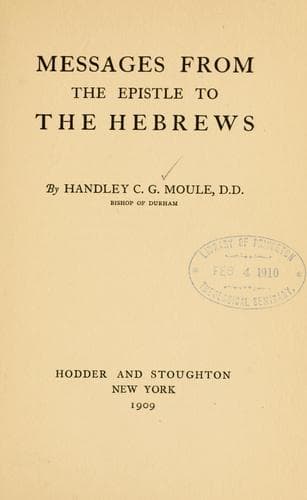
Messages from the Epistle to the HebrewsMoule, H. C. G. (Handley Carr Glyn)
Religion
Messages from the Epistle to the Hebrews
Moule, H. C. G. (Handley Carr Glyn)
Bible. Hebrews -- Commentaries
The paragraph before us is largely concerned with the inner life of the
believing community, its cohesion member with member, and the call to
each member and to all to "walk warily in dangerous days," in the path
of evangelical holiness. The Writer lays it upon them (ver. 14) to
"pursue peace with all," such peace as always _tends_, even in bad
times, to reward the "sons of peace," while they so behave themselves as
never on their own part to contribute a factor to avoidable strife, and
while the influence of their meek consistency leavens in some measure
the mass around them. With equal and concurrent care they are to "pursue
sanctification." It is to be their strong ambition to develope and
deepen incessantly that dedication of themselves to the Holy One which
will give them at once the standard and the secret of holiness, by
bringing them into immediate contact with Him who is at once their law
and their life. They are to "live out," in the spirit of a resolute
quest after fuller and yet fuller attainment, the fact that He has
redeemed them to be "a people of His own possession"; remembering, with
a solemn simplicity of conviction, that only "the pure in heart" shall
ever be able to "see God." For the spirit which refuses to come into a
surrendered harmony with His Spirit might be set in the midst of heaven
itself, yet it would be blind, it would be blinded--by that _alien_
glory. They are to keep watch and oversight upon one another (ver. 15),
mutually observant all round, to see that the life of faith and love is
alive indeed. Does any one find his fellow-believer "falling short of
the grace of God," sinking into conduct no better than the world's? This
must at once disquiet the observer, and call out his loving warnings, or
at least his anxious intercessions; for the declining convert inevitably
extends an influence of decline around him, and the issue will be, in
the end, a declining Church. Is "any root of bitterness growing up"? Is
there (see Deut. xxix. 18) any Christian in the company so fallen, so
"embittered" by alienation from his Lord, as to be a cause around him of
"defilement," so as to stain ultimately large circles ([Greek: hoi
polloi]) with the deep pollution of a practical apostasy from holiness?
Is there here and there a personal example of spiritual infidelity
([Greek: pornos]) to the Lord, of that radically "secular" ([Greek:
bebelos]) spirit (ver. 16) of which Esau is the type, to which some
"mess of meat," some material advantage, proves overwhelmingly more
momentous than the unworldly "birthright" given by the promise of God?
Let them all watch as for their life against such symptoms. It is a
matter of eternal import. The ancient Esau found too late that he was an
outcast, irrevocably, from the great blessing, though then he cried for
it with a cry great and bitter. In vain he asked his father to reverse
the destiny; there was no "place of repentance" in Isaac's will, for
Public-domain text, read in full here on John Shaqi.
Reviews
Reviews
No reviews yet
Be the first to share your thoughts on this work.
Join the Discussion
Join the discussion
Sign in to leave a comment or review.
Sign InorCreate an account