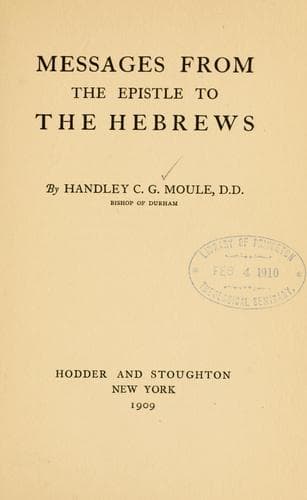
Messages from the Epistle to the HebrewsMoule, H. C. G. (Handley Carr Glyn)
Religion
Messages from the Epistle to the Hebrews
Moule, H. C. G. (Handley Carr Glyn)
Bible. Hebrews -- Commentaries
There is nothing that can serve as a substitute for this. The
"consideration" of our blessed Redeemer and King is not merely good for
us; it is vital. To "behold His glory," deliberately, with worship, with
worshipping love, _and seen by direct attention to the mirror of His
Word_, can and must secure for us blessings which we shall otherwise
infallibly lose. This, and this alone, amidst the strife of tongues and
all the perplexities of life, can develope in us at once the humblest
reverence and the noblest liberty, convictions firm to resist a whole
world in opposition, yet the meekness and the fear which utterly exclude
injustice, untruth, hardness, or the bitter word. For us if for any, for
us now if ever, this first great message of the Epistle meets a vital
need; "CONSIDER HIM."
CHAPTER II
A HEART OF FAITH
HEB. iii.
We have just endeavoured to find a message, "godly and wholesome, and
necessary for these times," in the opening paragraphs in the Epistle to
the Hebrews. We come now to interrogate our oracle again, and we open
the third chapter as we do so.
Here again we find the Epistle full, first, of "Jesus Christ Himself."
He is "the Apostle and the High Priest of our profession" (ver. 1), or
let us read rather, "our confession," the "confession" of us who are
loyal to His Name as His disciples. We are expressly called here to do
what the first two chapters implied that we must do--to "consider Him"
(ver. 1), to bend upon His Person, character, and work the attention of
the whole heart and mind. We are pointed to His holy fidelity to His
mission (ver. 2) in words which equally remind us of His subordination
to the Father's will and of His absolute authority as the Father's
perfect Representative. We are reminded (ver. 3) of that magnificent
other side of His position, that He acts and administers in "the house
of God" not as a servant but as the Father's "own SON (ver. 6) that
serveth Him." Nay, such is He that the "house" in which He does His
filial service is a building which He Himself has reared (ver. 3); He is
its Architect and its Constructor in a sense in which none could be who
is not Divine. Yes, He is no less than God (ver. 4); God Filial, God so
conditioned that He is also the faithful Sent-One of the Father, but
none the less GOD. We saw Him already in the first chapter (ver. 10),
placed before us in His majesty as the Originator of the material
Universe, to whom the starry skies are but His robe, to be put on and
put off in season. Here He is the doer of a yet more wonderful
achievement; He is the Builder of the Church of the Faithful. For the
"house" which He thus built is nothing else than "we" (ver, 6), we who
by faith have entered into the structure of the "living stones" (see 1
Pet. ii. 5), and who, by "the confidence and the rejoicing of our hope,"
abide within it.
Public-domain text, read in full here on John Shaqi.
Reviews
Reviews
No reviews yet
Be the first to share your thoughts on this work.
Join the Discussion
Join the discussion
Sign in to leave a comment or review.
Sign InorCreate an account