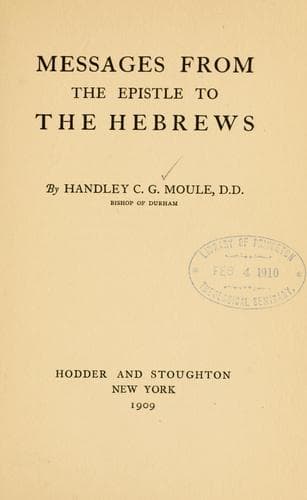
Messages from the Epistle to the HebrewsMoule, H. C. G. (Handley Carr Glyn)
Religion
Messages from the Epistle to the Hebrews
Moule, H. C. G. (Handley Carr Glyn)
Bible. Hebrews -- Commentaries
Thus the blessed Lord is before us here again, filling our sphere of
thought and contemplation. It is here just as it is in the Epistle to
the Colossians. There, as here, errors and confusions in the Church are
in view--a subtle theosophy and also a retrograde ceremonialism,
probably both amalgamating into one dangerous total. And St. Paul's
method of defence for his converts there--what is it? Above all, it is
the presentation of Jesus Christ, in the glories of His Person and His
Work. He places HIM in the very front of thought, first as the Head,
Founder, and Corner-stone of the Universe; then as the Head, Redeemer,
and Life of the Church. With HIM so seen he meets the dreamy thinker and
the ceremonial devotee; Christ is the ultimate and only repose, alike
for thought and for the soul.
In this Epistle as in that we have the same phenomenon, deeply
suggestive and seasonable for our life to-day. In both cases, not only
for individuals but for the Church, there was mental and spiritual
trouble. Alike in Phrygian Colossae and wherever the "Hebrews" lived
there was an invasion of church difficulties and confusion. A certain
affinity in detail links the two cases together. Colossian Christians
and Hebrew Christians, under widely different circumstances, and no
doubt in very different tones, persuasive in one case, threatening in
the other, were pressed to _retrograde_ from the sublime simplicity and
fulness of the truth. Their danger was what I may venture to call a
certain medievalism. Not Mosaism, not Prophetism, but Judaism, the
successor and distortion of the ancient revelations, invited or
commanded their adhesion, or, in the case of the "Hebrews," their
return, as to the one true faith and fold. There were great differences
in detail. At Colossae it does not seem that the "medievalists" professed
to deny Christianity; rather they professed to teach the Judaistic
version of it as the authentic type. Among the "Hebrews"
anti-Christianity was using every effort to allure or to alarm the
disciples back to open Rabbinism, "doing despite to the Son of God." But
both streams of tendency went in the same general direction so far that
they put into the utmost prominence aspects of religion full of a
traditional ceremonialism, and of the idea of human meritorious
achievement rather than of a spiritual reliance for the salvation of the
soul.
Public-domain text, read in full here on John Shaqi.
Reviews
Reviews
No reviews yet
Be the first to share your thoughts on this work.
Join the Discussion
Join the discussion
Sign in to leave a comment or review.
Sign InorCreate an account