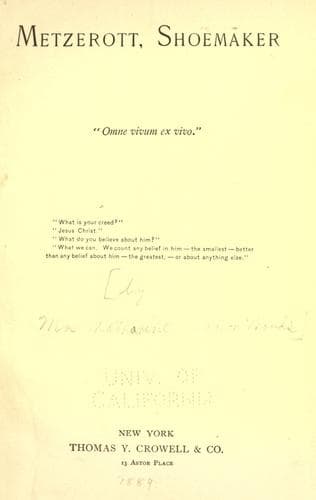
Christian socialism -- Fiction; German Americans -- Fiction; Shoemakers -- Fiction
“Oh, it’s all that,” said the man of knowledge easily; “but the fact is,
it didn’t pay. It was tried, you know. The man who owned it,—not the
inventor, who sold it for a song and was happy ever after, as the
story-books say,—but the man who bought it—well, he was pretty warm
about the pockets, so he did some extensive advertising, and started up
his works in fine style; but the machines cost like fun to make,
especially at first; if they had _taken_, you know, he could have run
things on a bigger scale, and so made ‘em cheaper; but they didn’t
_take_. They save muscle, of course; but you see most of us have muscle,
and very few of us money. That’s about the English of it, I guess. If
they’d saved _time_, now, or money, ’twould have been different.”
“What became of him?” asked Leppel gloomily.
“The inventor? don’t know; clever fellow, though, ought to succeed at
something; maybe not the first thing he tried, but something. Oh! you
mean the holder of the patent? Failed, and blew his brains out
afterwards; can’t say but it served him right, either.”
“It served him _quite_ right,” cried the inventor fiercely; “he took
advantage of the other man’s necessities”—
“But we all do that, you know, Mr. Rolf,” said the man of knowledge. “I
never came across a patent yet that was run on Gospel principles. What I
blame this fellow for is for letting himself go before he examined into
things. Pen and ink are cheap, and arithmetic taught for nothing; and he
ought to have known human nature well enough to see that he hadn’t
struck a paying job. Well, don’t be discouraged; go home and invent
something that is cheap to make, and knocks Father Time into the middle
of next week—some improvement in the telegraph, for instance, so a man
can hear yesterday how stocks stood day after to-morrow—and you’ll make
a fortune yet. Good-night. Oh, don’t mention it! I’ve really enjoyed our
little talk; took me back twenty years.”
Twenty years! So his fixed idea, his Moloch, to whom he had sacrificed
work, wife, and children, his machine that was to have enabled them to
live like princes, had been tried and failed, while he was still a happy
schoolboy in Germany! He took the night train for home, and sat gazing
into the blank darkness outside the window, his beloved model still
carefully cherished upon his knees,—why, he scarcely knew. The conductor
shook him twice before he heard the demand for his ticket, and then he
only turned his head and stared stupidly, so that the other took the bit
of pasteboard himself from the hat-band, where Leppel had mechanically
placed it.
“He ain’t drunk,” the conductor said to the brakeman, afterwards, as
they stood together on the front platform; “so he must be either crazy
or a blank fool.”
Public-domain text, read in full here on John Shaqi.
Reviews
Reviews
No reviews yet
Be the first to share your thoughts on this work.
Join the Discussion
Join the discussion
Sign in to leave a comment or review.
Sign InorCreate an account