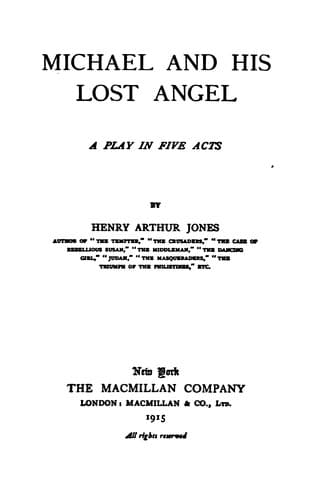
Michael and His Lost Angel: A Play in Five ActsJones, Henry Arthur
General
Michael and His Lost Angel: A Play in Five Acts
Jones, Henry Arthur
Adultery -- Drama; Clergy -- Drama; England -- Social life and customs -- 20th century -- Drama; English drama
MICHAEL AND HIS LOST ANGEL
_A PLAY IN FIVE ACTS_
BY
HENRY ARTHUR JONES
AUTHOR OF "THE TEMPTER," "THE CRUSADERS," "THE CASE OF
REBELLIOUS SUSAN," "THE MIDDLEMAN," "THE DANCING
GIRL," "JUDAH," "THE MASQUERADERS," "THE
TRIUMPH OF THE PHILISTINES," ETC.
New York
THE MACMILLAN COMPANY
LONDON: MACMILLAN & CO., LTD.
1920
_All rights reserved_
COPYRIGHT, 1895,
BY MACMILLAN AND CO.
Set up and electrotyped. Published May, 1896.
_Norwood Press_
J. S. Cushing & Co.--Berwick & Smith Co.
Norwood, Mass., U.S.A.
PREFACE
MICHAEL, though styled by Milton "of celestial armies prince," has
found his sword unequal to the task of combating the well-ordered
hosts of darkness,
By thousands and by millions ranged for fight.
The author of "Michael and his Lost Angel" seeks accordingly in print
consolation for the rebuffs he has experienced upon the stage. Some
comfort in the midst of defeat may be found in the fact that the gods
themselves fight vainly against prejudice and stupidity. I am not in
the least seeking to set aside the verdict pronounced by the majority
of "experts" upon Mr. Jones's latest play and subsequently accepted if
not ratified by the general public which would not be induced to see
it. All I seek to do is to deal so far as I am able with the adverse
influences to which it succumbed, and to explain why I think it a fine
work and in many respects a triumph.
The misfortunes of "Michael and his Lost Angel" attended, if they did
not anticipate, its conception. Like Marina in Pericles it had at least
as chiding a nativity
as play has often encountered. Before it saw the light a war had been
waged concerning its name. That the name itself involved as some
seemed to think a gratuitous insult to any form of religious
connection or was even ill chosen I am not prepared to grant. Michael
is not a scriptural character, and his functions, civil and militant,
and his place in the celestial hierarchy are assigned him by
uninspired writers. But for the use made of him in art and by Milton
it is doubtful whether his name would be familiar enough to the
general public to provoke a discussion. A discussion was, however,
provoked and with a portion of those present the verdict was
pronounced before the piece had been given. An opening scene,
meanwhile, in which the very raison-d'être of the play is found, an
indispensable portion of the motive began too soon and was, through
the noise and disturbance caused by late arrivals, practically
unheard. The difficulty thus caused was never quite overcome, and the
nature of Michael Feversham's offence and the value of his expiation
were both partially misunderstood.
Public-domain text, read in full here on John Shaqi.
Reviews
Reviews
No reviews yet
Be the first to share your thoughts on this work.
Join the Discussion
Join the discussion
Sign in to leave a comment or review.
Sign InorCreate an account