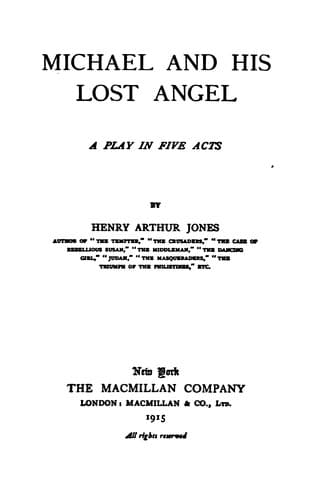
Michael and His Lost Angel: A Play in Five ActsJones, Henry Arthur
General
Michael and His Lost Angel: A Play in Five Acts
Jones, Henry Arthur
Adultery -- Drama; Clergy -- Drama; England -- Social life and customs -- 20th century -- Drama; English drama
That the display of human passions in a sacred edifice and the lavish
use of ecclesiastical ceremonial might cause offence I could have
conceived, had there not been the immediately previous proof of the
success of another play in which the very words of the Inspired
Teacher are used with a background of pagan revelry and a lavish and
superfluous display of nudity of limb. Paul of Tarsus is surely a more
recognisable personage, and one more closely connected with Christian
faith than a nebulous being such as Michael. While, however, the
slight banter in the title of Mr. Jones's play and the reproduction of
the rather florid pageant of the highest Anglican service has in a
work of earnest purpose and masterly execution wounded sensitive
consciences, the presentation as vulgar as inept of a portion of the
holiest mysteries of religion has been received with sacerdotal
benediction as well as with public applause. Foreign opinion
concerning English hypocrisy and prudery finds frequent utterance, and
our witty Gallic neighbours have excogitated a word they believe to be
English and take as the cant phrase of the Briton, _schoking._ We do
at times our best to furnish foreigners with a justification for their
views; and in the present case at least, we have shown our capacity to
"strain at a gnat and swallow a camel."
That the author has overburdened his work with dialogue is shown by
the result, since a play that the public will not have is naturally a
play unsuited to the public.
Some measure of the blame, to my thinking, almost the whole of the
blame, rests with the audience. In seeking to interest his world in a
series of duologues Mr. Jones has credited it with a knowledge of
dramatic art and an interest in psychology it does not possess. His
experiment is analogous to that undertaken in France by the younger
Dumas. A _première_ of Dumas was one of the most fashionable and
intellectual of Parisian "functions." With ears sharpened to acutest
attention the Parisian public listened not only to dialogue thrice as
long as any Mr. Jones has attempted, but also to monologue of the most
didactic kind. In the case of Victor Hugo again there is more than one
soliloquy of length absolutely portentous. These things have never
wearied a public art-loving, theatre-loving, before all appreciative
of literary subtlety and conscious of what are the true springs of
dramatic interest.
Public-domain text, read in full here on John Shaqi.
Reviews
Reviews
No reviews yet
Be the first to share your thoughts on this work.
Join the Discussion
Join the discussion
Sign in to leave a comment or review.
Sign InorCreate an account