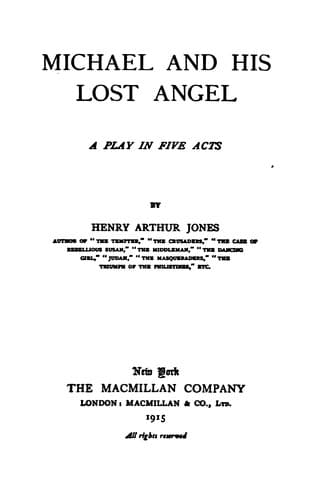
Michael and His Lost Angel: A Play in Five Acts — John Shaqi
Michael and His Lost Angel: A Play in Five ActsJones, Henry Arthur
General
Michael and His Lost Angel: A Play in Five Acts
Jones, Henry Arthur
Adultery -- Drama; Clergy -- Drama; England -- Social life and customs -- 20th century -- Drama; English drama
MICH. (_the moment she has entered closes door decisively, then turns
round on her very sternly_). What brings you to this village, to my
church, to my house? Why are you here? Come to me as a penitent, and I
will try to give you peace! Come to me as a woman of the world, and I
will tell you "The friendship of the world is enmity with God. It
always has been so, it always will be. The Church has no need of you,
of your pretended devotions, of your gifts, of your presence at her
services. Go your way back to the world, and leave her alone." But you
come neither as a penitent, nor as a woman of the world. You come
like--like some bad angel, to mock, and hint, and question, and
suggest. How dare you play with sacred things? How dare you?!
AUDR. (_very low, quiet, amused voice_). I do not think it seemly or
becoming in a clergyman to give way to temper. If anyone had asked me
I should have said it was impossible in you.
(_He stands stern, cold, repellent._)
_Enter ANDREW._
MICH. What is it, Andrew?
ANDR. I thought you were disengaged. (_Going._)
MICH. So I am. I'll come to you at once.
(_Exit ANDREW._)
MICH. (_to AUDRIE_). You are right. It is unseemly to give way to
temper, and perhaps you won't think me rude if I guard myself against
it in future by asking you not to call upon me until I can be of real
service to you. Good morning.
AUDR. Mr. Feversham, Mr. Feversham. (_MICHAEL turns._) I've been very
rude and troublesome. I beg your pardon. Please forgive me.
MICH. Certainly. Pray say no more.
AUDR. I saw you kissing that portrait as I stood at the window. It is
your mother?
MICH. Yes.
AUDR. What a good woman she must have been! Don't think because I am
bad----
MICH. Are you bad?
AUDR. Didn't you say I was? I don't know whether I'm bad or good, but
I know that no woman longs to be good more than I do--sometimes.
MICH. Do you indeed?
AUDR. (_impulsively_). Let me kiss that portrait!
(_Leaning forward to do it._)
MICH. (_peremptorily_). No.
(_Intercepts and stops her._)
AUDR. Why not?
MICH. I'd rather you didn't.
AUDR. You don't think I'm good enough.
MICH. I cannot allow you.
AUDR. Who painted it?
MICH. A young Italian. My mother's brother is a Catholic priest, and
at that time he was living at Rome. My mother went there for her
health when I was three years old. This young Italian saw her and
asked permission to paint her. She came home and died of consumption.
Then my uncle sent this portrait to my father with the news that the
young painter had also died of consumption.
AUDR. How strange! And you've had it ever since?
MICH. I was only a child when it came. I fell into the habit of saying
my prayers before it. So when I first left home my father gave it to
me; it has been with me ever since, at Eton, and Oxford, and in my
different curacies.
AUDR. Won't you let me kiss it before I go?
(_Leaning towards it._)
MICH. (_preventing her_). I'd rather you did not.
AUDR. Why not?
Public-domain text, read in full here on John Shaqi.
Reviews
Reviews
No reviews yet
Be the first to share your thoughts on this work.
Join the Discussion
Join the discussion
Sign in to leave a comment or review.
Sign InorCreate an account