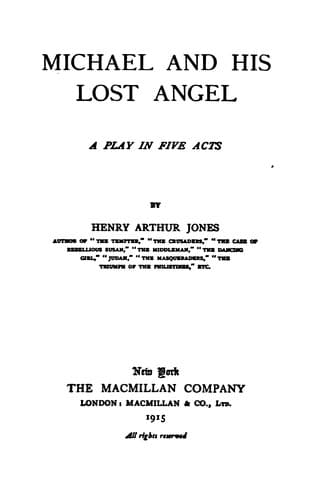
Michael and His Lost Angel: A Play in Five ActsJones, Henry Arthur
General
Michael and His Lost Angel: A Play in Five Acts
Jones, Henry Arthur
Adultery -- Drama; Clergy -- Drama; England -- Social life and customs -- 20th century -- Drama; English drama
At the moment when these lines are written, the London playgoer, not
perhaps of the most fashionable class, receives with delight a scene
in which a hero swims to the rescue of injured innocence, which a
generation ago established the fortunes of a dramatist and a theatre.
I refer, of course, to the Colleen Bawn of Dion Boucicault, which has
once more been revived. The rescue scene in this hit exactly the sense
of the English public and fulfilled its ideal. For a year or two
afterwards the intellect of our dramatists was exercised as to the
means by which virtue imperilled could be rescued, whether by climbing
a tower or swinging by a tree, or by any other contrivance involving
the risk of a broken neck. Those days, happily, are past. We have not,
however, made great progress in our education, and seem yet to have to
learn that the most telling drama is the psychological, and that
dialogue moves us, or should move us, more than incident. Othello, in
some respects the most poignant of tragedies, is nearly all duologue,
the gradual poisoning of the Moor's mind by Iago being one of the most
tremendous scenes ever attempted. The Greeks, the great art-loving
people of antiquity, banished in tragedy all incident from the stage,
and in this respect have been copied by the great school of French
classicists.
So far, without any very direct purpose or intention, I have been
posing, apparently, as the apologist for Mr. Jones's play. Underneath
this, perhaps, some few may have traced a design still less definite
of apologising for the English public. Nothing is further from my
intention than to proffer an excuse for what I regard as a fine and
most moving drama. For myself, I can only say that rarely indeed have
my entrails been stirred by more forcible pathos, my attention been
rapt by more inspiriting a theme, and my intellect been satisfied by
dialogue more natural, appropriate, and, in the highest sense,
dramatic. In one respect, I am disposed at times to agree with some of
Mr. Jones's censors. The logic of events which brings about the scene
in the island is, perhaps, not sufficiently inexorable. That Mrs.
Lesden is, in the eyes of the world, hopelessly compromised when she
spends a night alone on the island with her lover, I will concede. I
can conceive, however, Michael treating her with the more delicacy
therefor, abandoning to her his house, and spending a summer night, no
enormous penalty, in the open air, on the seashore. This, however,
only means that the overmastering influence of passion over Michael
has not been fully exhibited in action.
Public-domain text, read in full here on John Shaqi.
Reviews
Reviews
No reviews yet
Be the first to share your thoughts on this work.
Join the Discussion
Join the discussion
Sign in to leave a comment or review.
Sign InorCreate an account