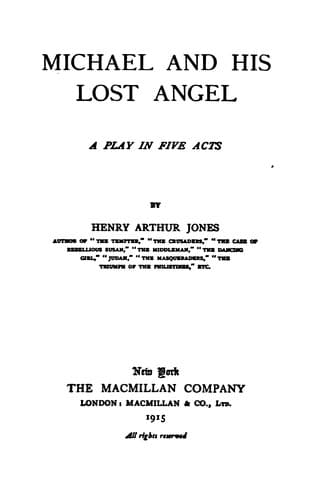
Michael and His Lost Angel: A Play in Five ActsJones, Henry Arthur
General
Michael and His Lost Angel: A Play in Five Acts
Jones, Henry Arthur
Adultery -- Drama; Clergy -- Drama; England -- Social life and customs -- 20th century -- Drama; English drama
With Mr. Jones's previous works--with "Judah," "The Crusaders,"
"Saints and Sinners"--"Michael and his Lost Angel" is connected by
strong, albeit not too evident, links. The bent of Mr. Jones's mind,
or the effect of his early environment, seems to force him into
showing the struggle between religious or priestly training, and high
and sincere aspiration, on the one hand, and, on the other, those
influences, half earthly, half divine, of our physical nature, which
sap where they cannot escalade, and, in the highest natures, end
always in victory. There is nothing in Michael Feversham of the
hypocrite, little even of the Puritan. Subject from the outset to
priestly influences, and wedded to theories of asceticism, the more
binding as self-imposed, he has come to look upon the renegation of
the most imperative as well as, in one sense, the holiest functions of
our nature as the condition of moral regeneration. _Sic itur ad
astra._ Crime, generally, he holds as condemnable, but murder and
theft are things aloof from the human nature with which he has to
deal. They are exceptional products of diseased organisations or
untoward surroundings. Not one of his flock that he is conducting
peacefully and unwittingly to Rome, is coming to him to own in
confession to having stolen an umbrella from a rack or a book from a
stall, still less to having slain his enemy on a secret path. Had such
confession been made, it would have been an episode of comparatively
little interest, a mere skirmish in the war he constantly sustains
against the forces of evil. Uncleanness, on the other hand, as he
elects to describe it, is the one offence against the higher life, in
regard to which, whether as concerns inward promptings or outside
manifestation, it behooves him to be ever armed and vigilant.
Accepting this theory, which, though subversive of the highest and
most obvious aims of nature, is still held by a considerable section
of civilised humanity, the conduct of Michael wins a measure of
sympathy. In imposing upon Rose Gibbard the unutterably shameful and
humiliating penance, the nature of which reaches us from the ferocious
Calvinism of the Puritan rather than from the gentler moral discipline
of the Romish church, to which he is hastening, Michael is thoroughly
sincere and conscientious. He believes it the best, nay, the only way
to save her soul and restore her to the self-respect and dignity of
pure womanhood. So much in earnest is he that, when Mrs. Lesden
propounds the theory, which among the virtuous and generous wins
acceptance, that "it is nearly always the good girls who are
betrayed," he resents the utterance as a levity, not to say a
profanity. A character such as this is not only conceivable, it is
well known. There is nothing in its psychology to scare the unthinking
or alarm the vulgar. In the humiliation which Michael is himself
compelled to undergo, I find at once the vindication of a morality
Public-domain text, read in full here on John Shaqi.
Reviews
Reviews
No reviews yet
Be the first to share your thoughts on this work.
Join the Discussion
Join the discussion
Sign in to leave a comment or review.
Sign InorCreate an account