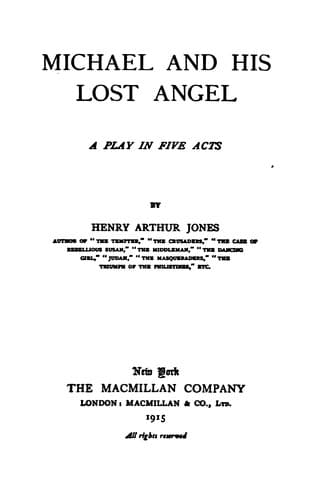
Michael and His Lost Angel: A Play in Five ActsJones, Henry Arthur
General
Michael and His Lost Angel: A Play in Five Acts
Jones, Henry Arthur
Adultery -- Drama; Clergy -- Drama; England -- Social life and customs -- 20th century -- Drama; English drama
In some respects the loves of Michael Feversham and Audrie Lesden seem
to take rank with the masterpieces of human passion, if not with Romeo
and Juliet, with Cupid and Psyche, with Paul and Virginia, and shall I
add with Edgar of Ravenswood and Lucy Ashton, at least with Helen and
Paris, Antony and Cleopatra, and Manon Lescaut and the Chevalier des
Grieux. Just enough of fatefulness as well as of human wilfulness is
there to add the crowning grace of tragedy by showing man the sport of
circumstance. Michael dwells on this point and finds "a curious bitter
amusement" in tracing out the sequence of events. "The hundred little
chances, accidents as we call them, that gave us to each other.
Everything I did to avoid you threw me at your feet. I felt myself
beginning to love you. I wrote urgently to Uncle Ned in Italy,
thinking I'd tell him and that he would save me. He came. I couldn't
tell him of you, but his coming kept Withycombe [the boatman] from
getting your telegram. I went to Saint Decuman's to escape from you.
You were moved to come to me. I sent away my own boat to put the sea
between us: and so I imprisoned you with me. Six years ago I used all
my influence to have the new lighthouse built on Saint Margaret's Isle
instead of Saint Decuman's, so that I might keep Saint Decuman's
lonely for myself and prayer. I kept it lonely for myself and you. It
was what we call a chance I didn't go to Saint Margaret's with Andrew
and my uncle. It was what we call a chance that you telegraphed to my
boatman instead of your own. If any one thing had gone differently--"
Even so. In this world, however, "nothing walks with aimless feet" and
the most commonplace and least significant of our actions may have
world-reaching results. "Oh, God bring back yesterday" is the
despairing cry which, since the beginning of time, has been wrung from
human lips.
Public-domain text, read in full here on John Shaqi.
Reviews
Reviews
No reviews yet
Be the first to share your thoughts on this work.
Join the Discussion
Join the discussion
Sign in to leave a comment or review.
Sign InorCreate an account