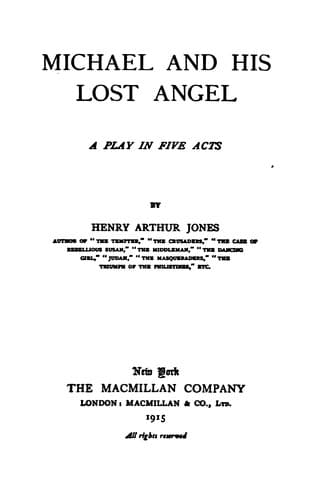
Michael and His Lost Angel: A Play in Five ActsJones, Henry Arthur
General
Michael and His Lost Angel: A Play in Five Acts
Jones, Henry Arthur
Adultery -- Drama; Clergy -- Drama; England -- Social life and customs -- 20th century -- Drama; English drama
The scene on the island seems to me admirable in management. I am not
sure that I care for Audrie's confession concerning the conquest of
the heart of "a cherub aged ten," though that leads to the very
humorous illustration of his sister's treason. Michael's own
confession on the other hand of his one flirtation with Nelly, the
tender osculation never repeated, and her farewell words "Good-night,
Mike" serve a distinct purpose in preparing Michael's ultimate
subjugation. "She called you Mike?" says Audrie with some surprise and
more bitterness. He is human then, this austere, ice-bound man only
just beginning to relent to her. His lips, those lips for which she
hungers, have been pressed upon a woman's face, and he has had a boy's
name by which another woman has dared to call him, a name her own lips
tremble to frame. She is long before she does frame it aloud. The idea
of that woman however dwells in her mind, and its full influence and
the extent of her surrender are shown when at what might be quite, and
is almost, the close of the third act she looks back and says, "Listen
to this. Whatever happens, I shall never belong to anybody but you.
You understand? I shall never belong to anybody but you, MIKE." All
this is supreme in tenderness and truthfulness and is the more
dramatic and convincing on account of its simplicity.
So it is throughout the play. There is not a moment when the effort
after rhetorical speech interferes with or mars the downright
earnestness and conviction of the language and the fervour of the
underlying emotion. The love-making so far as we are permitted to see
it is on the woman's side. Hers are the raptures, the reproaches, the
protestations. Only in the moment of supreme difficulty or defeat is
Michael tortured into amorous utterance, and then even it is the idea
of responsibility and possession that weighs upon him. The deed is
done, he belongs to the woman with whom he has sinned, the past is
ineffaceable: no expiation can alter, even if it may atone. He is,
moreover, impenitent in the midst of penitence, fiercely glad,
fiercely happy, in what he has done, ready to face all tribulation,
loss, and reproach, rather than sacrifice the burning, maddening,
joyous knowledge of his guilt. This is the spirit in which love in
strong, austere, unemotional natures manifests itself. "All for love
or the world well lost" is the title Dryden gives his alteration of
Antony and Cleopatra. All for love or heaven well lost is the phrase
Mr. Jones in effect puts into the lips of his Michael, a phrase used
not for the first time, and savouring of blasphemy or sanctity
according to the point of view of the audience.
There are perhaps higher ideals of love. What dramatist or preacher
has said anything finer than the words of the great cavalier lyrist:--
I could not love thee, dear, so much,
Loved I not honour more.
One of the best known of the Tudor dramatists, Habington, says:--
Public-domain text, read in full here on John Shaqi.
Reviews
Reviews
No reviews yet
Be the first to share your thoughts on this work.
Join the Discussion
Join the discussion
Sign in to leave a comment or review.
Sign InorCreate an account