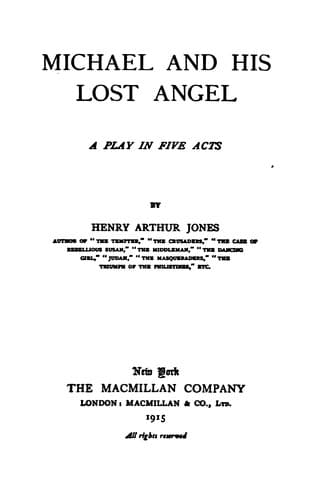
Michael and His Lost Angel: A Play in Five ActsJones, Henry Arthur
General
Michael and His Lost Angel: A Play in Five Acts
Jones, Henry Arthur
Adultery -- Drama; Clergy -- Drama; England -- Social life and customs -- 20th century -- Drama; English drama
He is but
A coward lover, whom or death or hell
Can fright from 's Mistress.
The enormity of Michael's sacrifice, the very unpardonableness of his
offence, constitute the sweetest savour to him as to her. To her it
brings an intoxicating, a delirious triumph, to him a sense how much
he must hug to himself and cherish a possession secured at so fearful
a price.
It is perhaps the distinguishing characteristic of Michael's madness
that the sin once committed is not repented. Landor talks of
Modesty who when she flies
Is fled for ever.
This is true of other things beside modesty. Not seldom it is true of
virtue. Sin is our sad portion, let us make the best of it. If we may
not have a "stately pleasure-house" of love, let us get what shelter
we may and at least cling close together while the winds of censure
rebuke and the rains of scandal chill. This is, of course, what Audrie
would suggest. "My beloved is mine and I am his." What matter
concerning other things, what other thing is there to matter? Not so
Michael. Lead me back, he says, to the ways of peace and purity. Let
us march hand in hand to the throne of forgiveness. There is no such
throne, says the moralist and the priest within him. "Can one be
pardoned and retain the offence?" he asks with Claudius, and the
answer extracted from his conscience is a negative. After her death, a
death for which he is, as he knows, mainly responsible, he abandons
all struggle, resigns his volition and his being into the hands of a
church that demands implicit obedience and pardons no questioning of
its decisions and decrees, and taking upon himself monastic vows
enters permanently a cloister.
If this is not according to the present reading of the word "tragedy,"
I know not where tragedy is to be sought. It may be that the subject
is one that cannot with advantage be set before the public with the
fierce and brilliant illumination of stage presentation. Compare
however the method of treatment, earnest, severe, resolute,
unfaltering, with that which was adopted by novelists dealing with
clerical trials and offences of the sort from the time of Diderot to
that of L'Abbé Michon, the reputed author of "La Réligieuse," "Le
Maudit," and other works of the class.
Once more I repeat that "Michael and his Lost Angel" is the best play
Mr. Jones has given the stage and is in the full sense a masterpiece.
It is the work of a man conscious of strength, and sure of the weapons
he employs. Whether the stage will know it again who shall say? It
will at least take rank as literature and in its present shape appeal
to most readers capable of having an independent opinion and clearing
their minds of cant.
Public-domain text, read in full here on John Shaqi.
Reviews
Reviews
No reviews yet
Be the first to share your thoughts on this work.
Join the Discussion
Join the discussion
Sign in to leave a comment or review.
Sign InorCreate an account