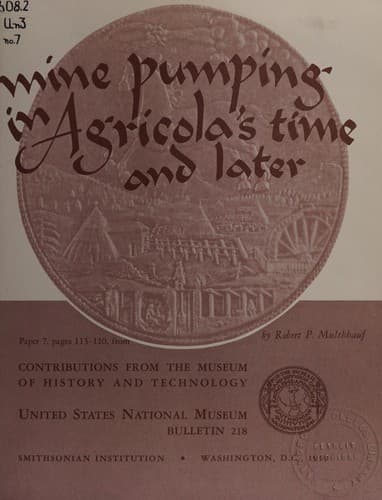
Mine Pumping in Agricola's Time and LaterMulthauf, Robert P.
History
Mine Pumping in Agricola's Time and Later
Multhauf, Robert P.
Mine pumps -- History; Mining machinery -- History
It seems, therefore, that Lohneyss' "old miners" were those described by
Agricola, and that the mine-hauling machinery used in central European
mines changed in the century after him far more than has been
recognized.[20] This thesis may further cast some light on other
technological questions. The connection between the urgency of the
problem of mine drainage in England, and the invention of the steam
engine, has often been suggested.[21] Perhaps the "backwardness" of
Germany in steam-engine experimentation, and later in the introduction
of the Newcomen engine, was to some extent due to the adequacy of
existing machinery to meet the problem of mine flooding, for it is not
clear that this problem existed on the continent.[22]
[Illustration: Figure 8.--THE WATERWORKS AT MARLY-LE-ROI, ON THE SEINE
RIVER, BUILT IN 1684 TO SUPPLY THE FOUNTAINS AT THE ROYAL PALACE AT
VERSAILLES. From a print by de Fer, 1705. (_Smithsonian photo 45593._)]
A comparison of the techniques described by Agricola with those of a
century later suggests that this was a century of significant progress
in that earlier industrial revolution described by Mumford as his
"Eotechnic phase," characterized by "the diminished use of human beings
as prime movers, and the separation of the production of energy from its
application and immediate control."[23]
Footnotes:
[1] W. B. Parsons, _Engineers and engineering in the Renaissance_,
Baltimore, 1939. Abraham Wolf, _A history of science, technology, and
philosophy in the 16th and 17th centuries_, New York, 1935; and _A
history of science, technology and philosophy in the eighteenth
century_, London, 1938. C. M. Bromehead, "Mining and quarrying to the
seventeenth century," in Charles Singer and others, _A history of
technology_, vol. 2, Oxford, 1956.
[2] According to Parsons (_op. cit._, footnote 1, p. 629) the
introduction of machinery worked by animals and falling water, "radical
improvements" of the 15th century, fixed the development of the art
"until the eighteenth, and, in some respects, even well into the
nineteenth century." Wolf in his _History of science ... in the
eighteenth century_ (p. 629, see footnote 1) agrees, saying that "apart
from [the steam engine] mining methods remained [during the 18th
century] essentially similar to those described in Agricola's _De re
metallica_." Bromehead (_op. cit._, footnote 1, p. 22), in referring to
the date 1673 also sees "no appreciable change in methods of mining
since Agricola."
[3] Parsons, _op. cit._ (footnote 1), p. 179. T. A. Rickard, _Man and
metals_, New York, 1932, vol. 2, pp. 519-521.
[4] Heinrich Bechtel, _Wirtschaftstil des deutschen Spaetmittelalters_,
Munich, 1930, pp. 202-203. Bechtel calls this one of the most
revolutionary industrial developments of the middle ages.
Public-domain text, read in full here on John Shaqi.
Reviews
Reviews
No reviews yet
Be the first to share your thoughts on this work.
Join the Discussion
Join the discussion
Sign in to leave a comment or review.
Sign InorCreate an account