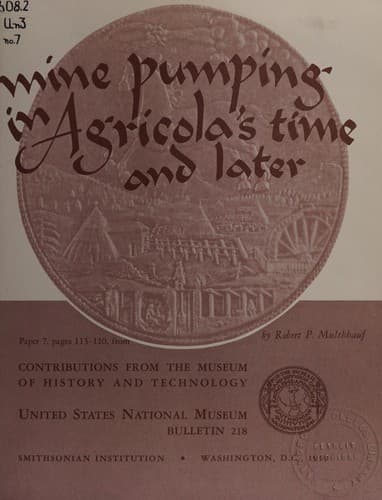
Mine Pumping in Agricola's Time and Later — John Shaqi
Mine Pumping in Agricola's Time and LaterMulthauf, Robert P.
History
Mine Pumping in Agricola's Time and Later
Multhauf, Robert P.
Mine pumps -- History; Mining machinery -- History
[14] O. Fritsche and A. Wagenbreth, "Die Wasserhaltungs-maschinen bei
Agricola und sein Einfluss auf ihre weitere Entwicklung," in _Deutsche
Akademie der Wissenschaft zu Berlin_, _Georgius Agricola_, (East)
Berlin: Akademie Verlag, 1953, p. 112.
[15] Hennig Calvoer, _Acta historico-chronologico-mechanica circa
Metallurgiam ..._, Braunschweig, 1763, pp. 36-37.
[16] I have been unable to find an early reference to this innovation,
which appears in a sketch of 1784-85 illustrating Conrad Matschoss',
"Die Maschinen des deutschen Berg- und Huettenwesens vor 100 Jahren,"
_Beitraege zur Geschichte der Technik und Industrie_ (1909), Band I, p.
7. Its introduction may be connected with the appearance of the term
Rosskunst for the horse windlass, known earlier as the Goepel.
[17] "Bericht des Bergverwalters Martin Planer ueber den Stand des
Freiberger Bergbaues im Jahre 1570," ed. R. Wengler, _Mittheilungen
Freiberger Altertumsverein_, 1898, vol. 35, pp. 75-83.
[18] The description of the Stangenkunst in its various modifications is
one of the chief topics of the previously cited work of Calvoer (footnote
15), and from his and other references it is clear that the subject was
also treated extensively by such earlier writers as Lohneyss (1617) and
Roessler (1700).
[19] Fritsche and Wagenbreth, _op. cit._ (footnote 14), p. 112.
[20] The hauling of ores, as opposed to water, seems to have remained as
shown by Agricola until the end of the 17th century. In 1694, however,
the famous Swedish engineer Christopher Polhem built at Falun a
water-powered conveyer system which brought the ore from the point of
origin in the mine to the smelter in a single operation, terminating
with the automatic unloading of the buckets (Vogel, _op. cit._, footnote
10, p. 306).
[21] Dickinson, H. W., _A short history of the steam engine_, New York,
n. d., p. 3.
[22] In 1673 Edward Browne visited Hungary and the Erzgebirge. His
report on the trip, _A brief account of some travels in diverse parts of
Europe_ (2nd ed., London, 1685, p. 170), says little about machinery,
but does not mention flooding as a serious problem. Of an 84-fathom mine
called Auff der Halsbrucker, near Freiberg, he says "they are not so
much troubled with water, and have very good engines to draw water out."
Yet the chain of dippers and rag and chain pump were evidently fallen
into disuse, as they do not appear among the mining machines reported by
Fritsche and Wagenbreth as having been described by Lohneyss (1617) or
Roessler (1700); and Fritsche and Wagenbreth declare that German
hydraulic machinery was able to compete with the steam engine in mine
dewatering for some time into the 19th century (_op. cit._, footnote 14,
pp. 111, 112).
[23] Lewis Mumford, _Technics and civilization_, New York, 1934, p. 112.
Transcriber's Notes:
Passages in italics are indicated by _underscore_.
Printer's inconsistencies in hyphenation usage have been retained.
Public-domain text, read in full here on John Shaqi.
Reviews
Reviews
No reviews yet
Be the first to share your thoughts on this work.
Join the Discussion
Join the discussion
Sign in to leave a comment or review.
Sign InorCreate an account