Mineral Survey Procedures Guide, 1980 — John Shaqi
Mineral Survey Procedures Guide, 1980
Science
Mineral Survey Procedures Guide, 1980
Cadastres -- United States; Mineral resources conservation -- United States
Common improvements require special consideration. See Sections 10–55,
10–56, and 10–57 of the Manual of Surveying Instructions. A common
improvement is one that tends to benefit several claims of a common
group. It must have been constructed in its entirety subsequent to the
location of each claim of the group, or at least $500 must have been
spent on the improvement subsequent to the location of each claim of the
common group. All claims within range of benefit must be included, even
though they were previously surveyed, or if they are locations which are
not included in the survey. The field notes must recite all the claims
involved, whether previously surveyed or unsurveyed.
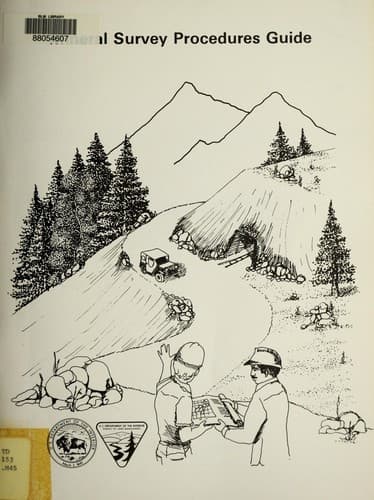
[Illustration]
[Illustration:
OPEN PIT MINES
]
[Illustration:
AN ACCESS ROAD IN RUGGED AREA. SUCH ROADS DO NOT AS A RULE COUNT
TOWARD PATENT EXPENDITURE.
]
[Illustration:
AN ADIT (TUNNEL) LEADING TO EXTENSIVE UNDERGROUND WORKINGS
]
Improvements need not be surveyed with the same accuracy as the claim
boundaries. Stadia measurements are acceptable, although they should be
made with a Philadelphia Rod and distances kept under 500 feet. Small
workings may be measured with a Brunton Compass and steel tape, but some
point of the working, such as the mouth of a tunnel or cut, must be tied
to a corner of the survey using a transit.
Surveys of extensive underground workings may be taken from the
claimant’s records if such surveys were executed under the supervision
of a mining engineer.
Extreme care should be exercised in entering old workings. In addition
to unsafe timbering, they may be poorly ventilated resulting in bad air
that could be fatal. Rather than risk an accident, the extent of such
workings can be estimated from the size of the dump.
Ties to discovery workings require special mention in view of the
directive from the Assistant Director of Technical Services, Washington,
D.C., dated March 15, 1978.
Normally the discovery working is on the lode or intersects it and a tie
is given along the lode line to the point of discovery, such as the face
of the discovery cut, the mouth of the discovery tunnel, the center of
the discovery shaft, etc.
However, in the case of blanket veins that are essentially horizontal a
presumed lode line or center line need not be shown, and the discovery
working may be anywhere on the claim. In such cases, the tie may be
given from the nearest corner of the survey and included in the
description of that corner, or a right angle tie may be given from a
point on the nearest end line.
Public-domain text, read in full here on John Shaqi.
Reviews
Reviews
No reviews yet
Be the first to share your thoughts on this work.
Join the Discussion
Join the discussion
Sign in to leave a comment or review.
Sign InorCreate an account