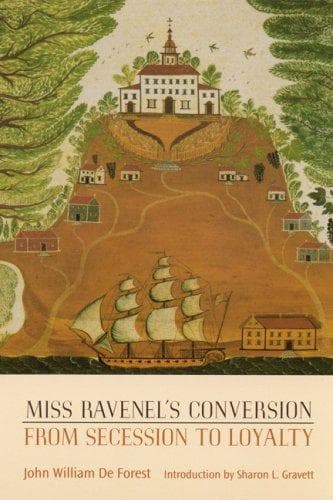
Miss Ravenel's conversion from secession to loyalty — John Shaqi
Miss Ravenel's conversion from secession to loyaltyDe Forest, John William
History
Miss Ravenel's conversion from secession to loyalty
De Forest, John William
Historical fiction; United States -- History -- Civil War, 1861-1865 -- Fiction; War stories; Women -- United States -- Fiction
Well, the evening passed away delightfully to the young patriot,
although it grieved his soul to find Miss Ravenel such a traitor to the
republic. It was nearly twelve when he bade the strangers good night and
apologized for staying so late, and accepted an invitation to call next
day, and hoped they would continue to live in New Boston. He actually
trembled with pleasure when Lillie at parting gave him her hand in the
frank southern fashion. And after he had reached his cosy bedroom on the
opposite side of the public square he had to smoke a segar to compose
himself to sleep, and succeeded so ill in his attempt to secure speedy
slumber that he heard the town clock ring out one and then two of the
morning before he lost his consciousness.
"Oh dear! papa, how he did hang on!" said Miss Ravenel as soon as the
door had shut behind him.
Certainly it was late, and she had a right to be impatient with the
visitor, especially as he was a Yankee and an abolitionist. But Miss
Ravenel, like most young ladies, was a bit of a hypocrite in talking of
young men, and was not so very ill pleased at the bottom of her heart
with the hanging on of Mr. Colburne.
CHAPTER II.
MISS RAVENEL BECOMES ACQUAINTED WITH LIEUTENANT-COLONEL CARTER.
Mr. Colburne was not tardy in calling on the Ravenels nor careless in
improving chances of encountering them by seeming accident. His modesty
made him afraid of being tiresome, and his sensitiveness of being
ridiculous; but neither the one terror nor the other prevented him from
inflicting a good deal of his society upon the interesting exiles. Three
weeks after his introduction it was his good fortune to be invited to
meet them at a dinner party given them by Professor Whitewood of his own
Alma Mater, the celebrated Winslow University.
The Whitewood house was of an architecture so common in New Boston that
in describing it I run no risk of identifying it to the curious.
Exteriorly it was a square box of brick, stuccoed to represent granite;
interiorly it consisted of four rooms on each floor, divided by a hall
up and down the centre. This was the original construction, to which had
been added a greenhouse, into which you passed through the parlor,
carefully balanced by a study into which you passed through the library.
Trim, regular, geometrical, one half of the structure weighing to an
ounce just as much as the other half, and the whole perhaps forming some
exact fraction of the entire avoirdupois of the globe, the very
furniture distributed at measured distances, it was precisely such a
building as the New Boston soul would naturally create for itself. Miss
Ravenel noticed this with a quickness of perception as to the relations
of mind and matter which astonished and amused Mr. Colburne.
Public-domain text, read in full here on John Shaqi.
Reviews
Reviews
No reviews yet
Be the first to share your thoughts on this work.
Join the Discussion
Join the discussion
Sign in to leave a comment or review.
Sign InorCreate an account