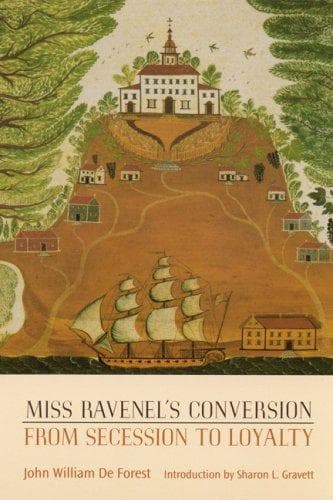
Miss Ravenel's conversion from secession to loyaltyDe Forest, John William
History
Miss Ravenel's conversion from secession to loyalty
De Forest, John William
Historical fiction; United States -- History -- Civil War, 1861-1865 -- Fiction; War stories; Women -- United States -- Fiction
"If I should be transported on Aladdin's carpet," she said, "fast
asleep, to some unknown country, and should wake up and find myself in
such a house as this, I should know that I was in New Boston. How the
Professor must enjoy himself here! This room is exactly twenty feet one
way by twenty feet the other. Then the hall is just ten feet across by
just forty in length. The Professor can look at it and say, Four times
ten is forty. Then the greenhouse and the study balance each other like
the paddle-boxes of a steamer. Why will you all be so square?"
"But how shall we become triangular, or circular, or star-shaped, or
cruciform?" asked Colburne. "And what would be the good of it if we
should get into those forms?"
"You would be so much more picturesque. I should enjoy myself so much
more in looking at you."
"I am so sorry you don't like us."
"How it grieves you!" laughed the young lady. A flush of rose mounted
her cheek as she said this; but I must beg the reader to recollect that
Miss Ravenel blushed at anything and nothing.
"Now here are buildings of all shapes and colors," she proceeded,
turning over the leaves of a photographic album which contained views of
Venetian architecture. "Don't you see that these were not built by New
Bostonians?"
They were in the library, whither Miss Whitewood had conducted them to
exhibit her father's fine collection of photographs and engravings. A
shy but hospitable and thoughtful maiden, incapable of striking up a
flirtation of her own, and with not a selfish matrimonial in her head,
but still quite able to sympathise with the loves of others, Miss
Whitewood had seated her two guests at their art banquet, and then had
gently withdrawn herself from the study so that they might talk of what
they chose without restraint. It was already reported, with or without
reason, that Mr. Colburne was interested in the fascinating young exile
from Louisiana, and that she was not so indifferent to him as she
evidently was to most of the New Boston beaux. This was the reason why
that awkward but good Miss Whitewood, twenty-five years old and without
a suitor, be it remembered, had brought them into the quiet of the
study. Meantime the door was wide open into the hall, and exactly
opposite to it was another door wide open into the parlor, where, in
full view of the young people, sat all the old people, meaning thereby
Doctor Ravenel, Professor Whitewood, Mrs. Whitewood, and her prematurely
middle-aged daughter. The three New Bostonians were listening with
evident delight to the fluent and zealous Louisianian. But, instead of
entering upon his conversation, which consisted chiefly of lively satire
and declamation directed against slavery and its rebellious partizans,
let us revert for a tiresome moment or two, while dinner is preparing
and other guests are arriving, to the subject on which Miss Ravenel has
been teasing Mr. Colburne.
Public-domain text, read in full here on John Shaqi.
Reviews
Reviews
No reviews yet
Be the first to share your thoughts on this work.
Join the Discussion
Join the discussion
Sign in to leave a comment or review.
Sign InorCreate an account