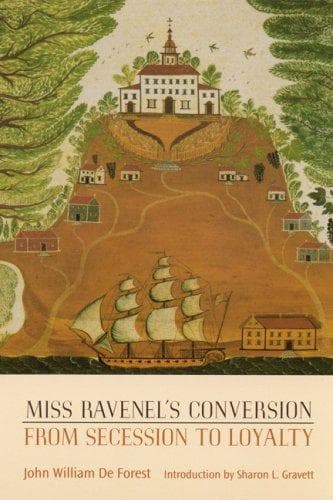
Miss Ravenel's conversion from secession to loyaltyDe Forest, John William
History
Miss Ravenel's conversion from secession to loyalty
De Forest, John William
Historical fiction; United States -- History -- Civil War, 1861-1865 -- Fiction; War stories; Women -- United States -- Fiction
Another annoyance to Colburne was Mrs. Larue. He was still so young in
heart matters, or rather in coquetry, that he was troubled by being made
the object of airs of affection which he could not reciprocate. I do not
mean to say that the lady was in love with him; she never had been in
love in her life, and was not going to begin at thirty-three. The plain,
placid truth was, that she was willing to flirt with him to please
herself, and determined to keep him away from Lillie in order to give
every possible chance to Carter. Only when Mrs. Larue said "flirt," she
meant indescribable things, such as ladies may talk of without reproach
among themselves, but which, if introduced into print, are considered
very improper reading. Meantime neither Carter nor Colburne understood
her, although the former would have hooted at the idea that he did not
comprehend the lady perfectly.
"By Jove!" soliloquized the knowing Colonel, "she is sweeter on him than
a pailful of syrup. She puts one in mind of a boa-constrictor. She is
licking him all over, preparatory to swallowing him. Not a bad sort of
serpent to have around one, either," pursued the Colonel, almost winking
to himself, so knowing did he feel. "Not a bad sort of serpent. Only I
shouldn't care about marrying her."
Indeed the Colonel reminds one a little of "devilish sly old Joey
Bagstock."
The innocent Colburne acknowledged to himself that he did not comprehend
Mrs. Larue nor her purposes. He would have inferred from her ways that
she wanted him for a husband, only that she spoke in a very cool way of
the matrimonial state.
"Marriage will not content me, nor will single life," she said to him
one day. "I have tried both, and I cannot recommend either. It is a
choice between two evils, and one does not know to say which is the
least."
Widows in search of second husbands do not talk publicly in this style,
and Colburne intelligently concluded that he was not to be invited to
the altar. At the same time Mrs. Larue went on in this way, she treated
him to certain appetizing little movements, glances and words, which led
him to suspect with some vague alarm that she did not mean to let him
off as a mere acquaintance. Finally, as is supposed, an explanation
ensued which was not to his liking. There was an interview of half an
hour in a back parlor, brought about by the graceful manoeuvres of the
lady, of which Colburne steadily refused to reveal the secrets, although
straitly questioned by the fun-loving Colonel.
"By Jove! he's been bluffing her," soliloquized Carter, who thought he
perceived that from this private confabulation the parties came forth on
terms of estrangement. "What a queer fellow he is! Suppose he didn't
want to marry her--he might amuse himself. It would be pleasant to him,
and wouldn't hurt her. Hanged if he isn't a curiosity!"
Public-domain text, read in full here on John Shaqi.
Reviews
Reviews
No reviews yet
Be the first to share your thoughts on this work.
Elsewhere in the archive
Join the Discussion
Join the discussion
Sign in to leave a comment or review.
Sign InorCreate an account