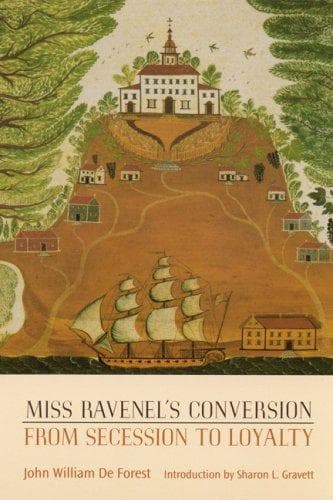
Miss Ravenel's conversion from secession to loyaltyDe Forest, John William
History
Miss Ravenel's conversion from secession to loyalty
De Forest, John William
Historical fiction; United States -- History -- Civil War, 1861-1865 -- Fiction; War stories; Women -- United States -- Fiction
The next time that Colburne called on Miss Ravenel the Larue took her
revenge for that mysterious defeat, the particulars of which I am unable
to relate. To comprehend the nature and efficiency of this vengeance, it
is necessary to take a dive into the recesses of New Orleans society.
There is a geographical fable of civilized white negroes in the centre
of Africa, somewhere near the Mountains of the Moon. This fable is
realized in the Crescent City and in some of the richest planting
districts of Louisiana, where you will find a class of colored people,
who are not black people at all, having only the merest fraction of
negro blood in their veins, and who are respectable in character,
numbers of them wealthy, and some of them accomplished. These Creoles,
as they call themselves, have been free for generations, and until
Anglo-Saxon law invaded Louisiana, enjoyed the same rights as other
citizens. They are good Catholics; they marry and are given in marriage;
their sons are educated in Paris on a perfect level with young
Frenchmen; their daughters receive the strict surveillance which is
allotted to girls in most southern countries. In the street many of them
are scarcely distinguishable from the unmixed descendants of the old
French planters. But there is a social line of demarkation drawn about
them, like the sanitary cordon about an infected district. The
Anglo-Saxon race, the proudest race of modern times, does not marry nor
consort with them, nor of late years does the pure French Creole, driven
to join in this ostracism by the brute force of Henghist and Horsa
prejudice. The New Orleanois who before the war should have treated
these white colored people on terms of equality, would have shared in
their opprobrium, and perhaps have been ridden on a rail by his outraged
fellow-citizens of northern descent.
Public-domain text, read in full here on John Shaqi.
Reviews
Reviews
No reviews yet
Be the first to share your thoughts on this work.
Elsewhere in the archive
Join the Discussion
Join the discussion
Sign in to leave a comment or review.
Sign InorCreate an account