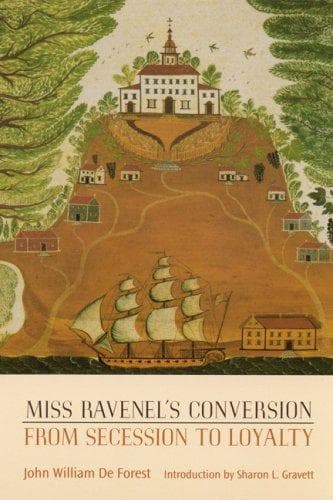
Miss Ravenel's conversion from secession to loyaltyDe Forest, John William
History
Miss Ravenel's conversion from secession to loyalty
De Forest, John William
Historical fiction; United States -- History -- Civil War, 1861-1865 -- Fiction; War stories; Women -- United States -- Fiction
Now these white negroes from the Mountains of the Moon constituted the
sole loyal class, except the slaves, which Butler found in Louisiana.
They and their black cousins of the sixteenth degree were the only
people who, as a body, came forward with joy to welcome the drums and
tramplings of the New England Division; and when the commanding General
called for regiments of free blacks to uphold the Stars and Stripes, he
met a patriotic response as enthusiastic as that of Connecticut or
Massachusetts. Foremost in this military uprising were two brothers of
the name of Meurice, who poured out their wealth freely to meet those
incidental expenses, never acknowledged by Government, which attend the
recruiting of volunteer regiments. They gave dinners and presented
flags; they advanced uniforms, sabres and pistols for officers; they
trusted the families of private soldiers. The youngest Meurice became
Major of one of the regiments, which I take to be the nearest approach
to a miracle ever yet enacted in the United States of America. Their
entertainments became so famous that invitations to them were gratefully
accepted by officers of Anglo-Saxon organizations. At their profuse yet
elegant table, where Brillât-Savarin would not have been annoyed by a
badly cooked dish or an inferior wine, and where he might have listened
to the accents of his own Parisian, Colburne had met New Englanders, New
Yorkers, and even stray Marylanders and Kentuckians. There he became
acquainted (ignorant Baratarian that he was!) with the _tasse de cafe
noir_ and the _petit verre de cognac_ which close a French dinner. There
he smoked cigars which gave him new ideas concerning the value of Cuba.
For these pleasures he was now to suffer at the Caucasian hands of
Madame Larue.
"I am afraid that we are doomed to lose you, Captain Colburne," she said
with a smile which expressed something worse than good-natured raillery.
"I hear that you have made some fascinating acquaintances in New
Orleans. I never myself had the pleasure of knowing the Meurices. They
are very charming, are they not?"
Colburne's nerves quivered under this speech, not because he was
conscious of having done any thing unbecoming a gentleman, but because
he divined the clever malice of the attack. To gentle spirits the
consciousness that they are the objects of spite, is a dolorous
sensation.
"It is a very pleasant and intelligent family," he replied bravely.
"Who are they?" smilingly asked Miss Ravenel, who inferred from her
aunt's manner that Colburne was to be charged with a flirtation.
"Ce sont des métis, ma chère," laughed Mrs. Larue. "Il y a dîné
plusieurs fois. Ces abolitionistes ont leur goûts à eux."
Public-domain text, read in full here on John Shaqi.
Reviews
Reviews
No reviews yet
Be the first to share your thoughts on this work.
Elsewhere in the archive
Join the Discussion
Join the discussion
Sign in to leave a comment or review.
Sign InorCreate an account