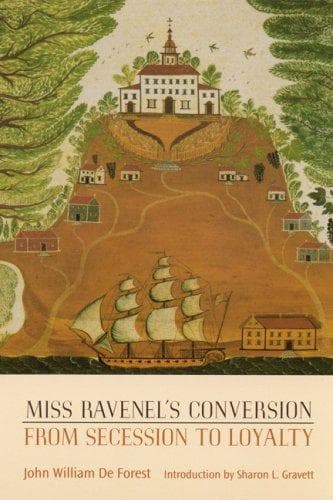
Miss Ravenel's conversion from secession to loyaltyDe Forest, John William
History
Miss Ravenel's conversion from secession to loyalty
De Forest, John William
Historical fiction; United States -- History -- Civil War, 1861-1865 -- Fiction; War stories; Women -- United States -- Fiction
Lillie colored crimson with amazement, with horror, with downright
anger. To this New Orleans born Anglo-Saxon girl, full of the pride of
lineage and the prejudices of the slaveholding society in which she had
been nurtured, it seemed a downright insult that a gentleman who called
on her, should also call on a _métis_, and admit it and defend it. She
glanced at Colburne to see if he had a word to offer of apology or
explanation. It might be that he had visited these mixed bloods in the
performance of some disagreeable but unavoidable duty as an officer of
the Federal army. She hoped so, for she liked him too well to be willing
to despise him.
"Intelligent? But without doubt," assented Madame, "if they had been
stupid, you would not have dined with them four or five times."
"Three times, to be exact, Mrs. Larue," said Colburne. He had formed his
line of battle, and could be not merely defiant but ironically
aggressive. But the lady was master of the southern tactics; she had
taken the initiative, and she attacked audaciously; although, I must
explain, without the slightest sign of irritation.
"Which do you find the most agreeable," she asked, "the white people of
New Orleans, or the brown?"
Colburne was tempted to reply that he did not see much difference, but
refrained on account of Miss Ravenel; and, dropping satire, he entered
on a calm defence, less of himself than of the mixed race in question.
He affirmed their intelligence, education, good breeding, respectability
of character, and exceptional patriotism in a community of rebels.
"You, Mrs. Larue, think something of the elegancies of society as an
element of civilization," he said. "Now then, I am obliged to confess
that these people can give a finer dinner, better selected, better
cooked, better served, than I ever saw in my own city of New Boston,
notwithstanding that we are as white as they are and--can't speak
French. These Meurices, for example, have actually given me new ideas of
hospitality, as something which may be plenteous without being coarse,
and cordial without being laboreous. I don't hesitate to call them nice
people. As for the African blood in their veins (if that is a reproach)
I can't detect a trace of it. I shouldn't have believed it if they
hadn't assured me of it. There is a little child there, a cousin, with
blue eyes and straight flaxen hair. She has the honor, if it is one, of
being whiter than I am."
It will be remembered here that any one who was whiter than Colburne was
necessarily much whiter than Mrs. Larue.
"When I first saw the eldest Meurice," he proceeded, "I supposed from
his looks that he was a German. The Major bears a striking resemblance
to the first Napoleon, and is certainly one of the handsomest men that I
have seen in New Orleans. His manners are charming, as I suppose they
ought to be, seeing that he has lived in Paris since he was a child."
Mrs. Larue had never transgressed the borders of Louisiana.
Public-domain text, read in full here on John Shaqi.
Reviews
Reviews
No reviews yet
Be the first to share your thoughts on this work.
Elsewhere in the archive
Join the Discussion
Join the discussion
Sign in to leave a comment or review.
Sign InorCreate an account