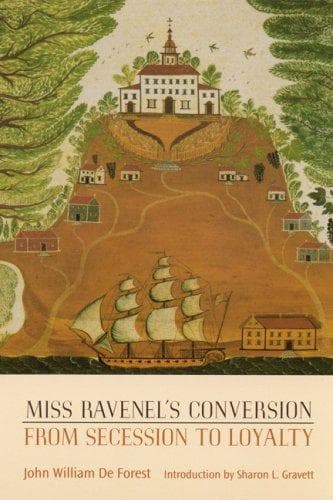
Miss Ravenel's conversion from secession to loyaltyDe Forest, John William
History
Miss Ravenel's conversion from secession to loyalty
De Forest, John William
Historical fiction; United States -- History -- Civil War, 1861-1865 -- Fiction; War stories; Women -- United States -- Fiction
New Boston is not a lively nor a sociable place. The principal reason
for this is that it is inhabited chiefly by New Englanders. Puritanism,
the prevailing faith of that land and race, is not only not favorable
but is absolutely noxious to social gayeties, amenities and graces. I
say this in sorrow and not in anger, for New England is the land of my
birth and Puritanism is the creed of my progenitors. And I add as a mere
matter of justice, that, deficient as the New Bostonians are in timely
smiles and appropriate compliments, bare as they are of jollities and
angular in manners and opinions, they have strong sympathies for what is
clearly right, and can become enthusiastic in a matter of conscience and
benevolence. If they have not learned how to love the beautiful, they
know how to love the good and true. But Puritanism is not the only
reason why the New Bostonians are socially stiff and unsympathetic. The
city is divided into more than the ordinary number of cliques and
coteries, and they are hedged from each other by an unusually thorny
spirit of repulsion. From times now far beyond the memory of the oldest
inhabitant, the capsheaf in the social pyramid has been allotted by
common consent, without much opposition on the part of the other
inhabitants, to the president and professors of Winslow University,
their families, and the few whom they choose to honor with their
intimacy. In early days this learned institution was chiefly theological
and its magnates all clerical; and it was inevitable that men bearing
the priestly dignity should hold high rank in a puritan community.
Eighty or a hundred years ago, moreover, the professor, with his salary
of a thousand dollars yearly was a nabob of wealth in a city where there
were not ten merchants and not one retired capitalist who could boast an
equal income. Finally, learning is a title to consideration which always
has been and still is recognized by the majority of respectable
Americans. An objectionable feature of this sacred inner circle of
society is that it contains none of those seraphim called young
gentlemen. The sons of the professors, excepting the few who become
tutors and eventually succeed their fathers, leave New Boston for larger
fields of enterprise; the daughters of the professors, enamored of
learning and its votaries alone, will not dance, nor pic-nic, much less
intermarry, with the children of shop-keepers, shippers and
manufacturers; and thus it happens that almost the only beaux whom you
will discover at the parties given in this Upper Five Hundred are
slender and beardless undergraduates.
Public-domain text, read in full here on John Shaqi.
Reviews
Reviews
No reviews yet
Be the first to share your thoughts on this work.
Join the Discussion
Join the discussion
Sign in to leave a comment or review.
Sign InorCreate an account