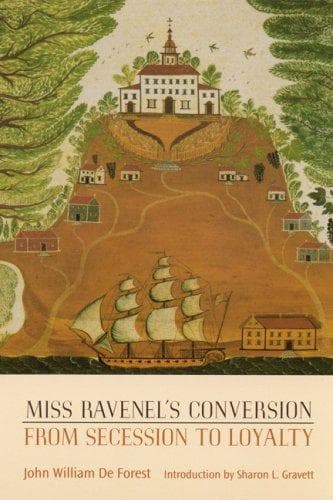
Miss Ravenel's conversion from secession to loyaltyDe Forest, John William
History
Miss Ravenel's conversion from secession to loyalty
De Forest, John William
Historical fiction; United States -- History -- Civil War, 1861-1865 -- Fiction; War stories; Women -- United States -- Fiction
"I consider him a very dangerous man; he might do a great deal of harm
if he chose," remarked one of those conscientious but uncharitable
ladies whom I have regarded since my childhood with a mixture of
veneration and dislike. Thin-lipped, hollow-cheeked, narrow-chested,
with only one lung and an intermittent digestion, without a single
rounded outline or graceful movement, she was a sad example of what the
New England east winds can do in enfeebling and distorting the human
form divine. Such are too many of the New Boston women when they reach
that middle age which should be physically an era of adipose, and
morally of charity. Even her smile was a woful phenomenon; it seemed to
be rather a symptom of pain than an expression of pleasure; it was a
kind of griping smile, like that of an infant with the colic.
"If he chose! What harm would he choose to do?" expostulated Colburne,
for whose ears this warning was intended.
"I can't precisely make out whether he is orthodox or not," replied the
inexorable lady. "And if he _is_ heterodox, what an awful power he has
for deceiving and leading away the minds of the young! He is altogether
too agreeable to win my confidence until I know that he is guided and
restrained by grace."
"That is the most unjust thing that I ever heard of," broke out Colburne
indignantly. "To condemn a man because he is charming! If the converse
of the rule is true, Mrs. Ruggles--if unpleasant people are to be
admired because they are such--then some of us New Bostonians ought to
be objects of adoration."
"I have my opinions, Mr. Colburne," retorted the lady, who was somewhat
stung, although not clever enough to comprehend how badly.
"It makes a great difference with an object who looks at it," continued
the young man. "I sometimes wonder what the ants think of us human
beings. Do they understand our capacities, duties and destinies? Or do
they look upon us from what might be called a pismire point of view?"
Public-domain text, read in full here on John Shaqi.
Reviews
Reviews
No reviews yet
Be the first to share your thoughts on this work.
Join the Discussion
Join the discussion
Sign in to leave a comment or review.
Sign InorCreate an account