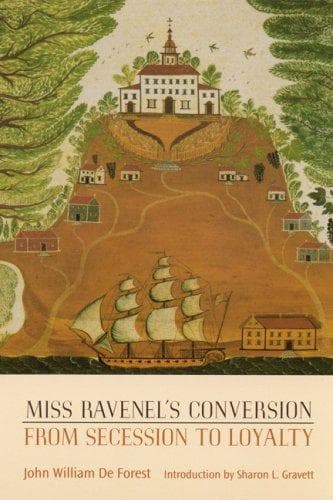
Miss Ravenel's conversion from secession to loyaltyDe Forest, John William
History
Miss Ravenel's conversion from secession to loyalty
De Forest, John William
Historical fiction; United States -- History -- Civil War, 1861-1865 -- Fiction; War stories; Women -- United States -- Fiction
At table the company was arranged as follows. At the head sat Mrs.
Whitewood, with Dr. Ravenel on her right, and Miss Whitewood on her
left. At the foot was the host, flanked on the right by Miss Ravenel and
on the left by Lieutenant-Colonel Carter. The two central side places
were occupied by young Whitewood and Colburne, the latter being between
Miss Whitewood and Miss Ravenel. With a quickness of perception which I
suspect he would not have shown had not his heart been interested in the
question he immediately decided that Doctor Ravenel was intended to go
_tête-a-tête_ with Mrs. Whitewood, and this strange officer with Miss
Ravenel, while he was to devote himself to Miss Whitewood. The worrying
thought drove every brilliant idea from his head. He could no more talk
and be merry than could that hermaphrodite soul whose lean body and
cadaverous countenance fronted him on the opposite side of the table.
Miss Whitewood, who was nearly as great a student as her brother, was
almost as deficient in the powers of speech; she made an effort, first
in the direction of the coming Presentation Day, then towards somebody's
notes on Cicero, finally upon the weather; at last, with a woman's
sympathetic divination, she guessed the cause of Colburne's gloom, and
sank into a pitying silence. As for Mrs. Whitewood, amiable woman and
excellent housewife, though an invalid, her conversational faculty
consisted in listening. Thus nobody talked except the Ravenels,
Lieutenant-Colonel Carter, and Professor Whitewood.
Colburne endeavored to conceal his troubled condition by a smile of
counterfeit interest in the conversation. Then he grew ashamed of
himself, and tearing off his fictitious smirk, substituted a look of
stern thought, thereby exhibiting an honest countenance, but not one
suitable to the occasion. There was sherry on the table; not because
wine-bibbing was a habit of the Whitewoods, inasmuch as the hostess had
brought it out of the family medical stores with a painful twinge of
conscience; but there it was, in deference to the supposed tastes of the
army gentleman and the strangers from the south. Colburne was tempted to
rouse himself with a glass of it, but did not, being a pledged member of
a temperance society. Instead of this he made a gallant moral effort,
and succeeded in talking copiously to the junior Whitewood. But as what
he said is of little consequence to our story, let us go back a few
moments and learn what it was that had depressed his spirits.
"I am delighted to meet some one from Louisiana, Miss Ravenel," said the
Lieutenant-Colonel, after the master of the house had said grace.
"Why? Are you a Louisianian?" asked the young lady with a blush of
interest which was the first thing that troubled Colburne.
"Not precisely. I came very near calling myself such at one time, I
liked the State and the people so much. I was stationed there for
several years."
"Indeed! At New Orleans?"
Public-domain text, read in full here on John Shaqi.
Reviews
Reviews
No reviews yet
Be the first to share your thoughts on this work.
Join the Discussion
Join the discussion
Sign in to leave a comment or review.
Sign InorCreate an account