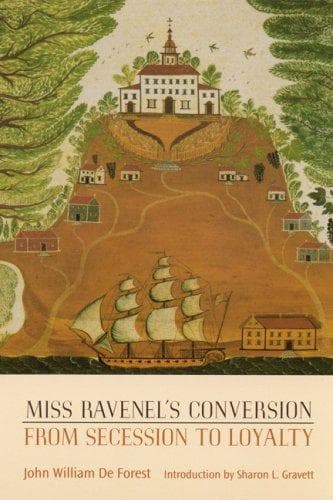
Miss Ravenel's conversion from secession to loyaltyDe Forest, John William
History
Miss Ravenel's conversion from secession to loyalty
De Forest, John William
Historical fiction; United States -- History -- Civil War, 1861-1865 -- Fiction; War stories; Women -- United States -- Fiction
"Not so fortunate," replied the Lieutenant Colonel with a smile and a
slight bow, which was as much as to say that, if he had been stationed
there, he might have hoped for the happiness of knowing Miss Ravenel
earlier. "I was stationed in the arsenal at Baton Rouge."
"I never was at Baton Rouge; I mean I never visited there. I have passed
there repeatedly in going up and down the river, just while the boat
made its landings, you know. What a beautiful place it is! I don't mean
the buildings, but the situation, the bluffs."
"Precisely. Great relief to get to Baton Rouge and see a hill or two
after staying in the lowlands."
"Oh! don't say anything against the lowlands," begged Miss Ravenel.
"I won't," promised the Lieutenant Colonel. "Give you my word of honor I
won't do it, not even in the strictest privacy."
There was a cavalier dash in the gentleman's tone and manner; he looked
and spoke as if he felt himself quite good enough for his company. And
so he was, at least in respect to descent and social position; for no
family in Virginia boasted a purer strain of old colonial blue blood
than the Carters. In addition the Lieutenant Colonel was a gentleman by
right of a graduation from West Point, and of a commission in the
regular service which dated back to the times when there were no
volunteers and few civilian appointments, and when by consequence army
officers formed a caste of aristocratic military brahmins. From the
regular service, however, in which he had been only a lieutenant, his
name had vanished several years previous. His lieutenant-colonelcy was a
volunteer commission issued by the governor of the State. It was in the
Second Barataria, a three-months' regiment, which was shortly to
distinguish itself by a masterly retreat from Bull Run. Carter had
injured his ancle by a fall from his horse, and was away from the army
on a sick leave of twenty days, avoiding the hospitals of Washington,
and giving up his customary enjoyments in New York for the sake of
attending to business which will transpire during this narrative. His
leave had nearly expired, but he had applied to the War Department for
an extension of ten days, and was awaiting an answer from that awful
headquarters with the utmost tranquillity. If he found himself in the
condition of being absent without leave, he knew how to explain things
to a military commission or a board of inquiry.
Public-domain text, read in full here on John Shaqi.
Reviews
Reviews
No reviews yet
Be the first to share your thoughts on this work.
Join the Discussion
Join the discussion
Sign in to leave a comment or review.
Sign InorCreate an account