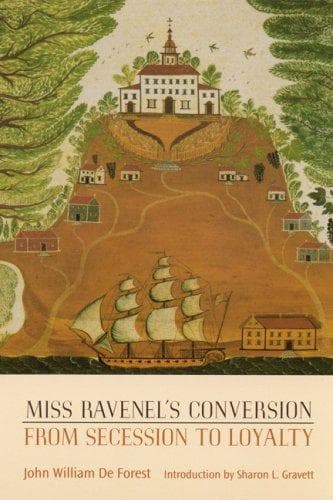
Miss Ravenel's conversion from secession to loyalty — John Shaqi
Miss Ravenel's conversion from secession to loyaltyDe Forest, John William
History
Miss Ravenel's conversion from secession to loyalty
De Forest, John William
Historical fiction; United States -- History -- Civil War, 1861-1865 -- Fiction; War stories; Women -- United States -- Fiction
The Lieutenant-Colonel, by the way, had taken to the wine in a style
which showed that he was used to the taste of it, and liked the effects.
His conversation grew more animated; his bass voice rang from end to end
of the table, startling Mrs. Whitewood; his fine brown eyes flashed, and
a few drops of perspiration beaded his brow. It must not be supposed
that the sherry alone could do as much as this for so old a campaigner.
That afternoon, as he lounged and yawned in the reading-room of the New
Boston House, he had thought of Professor Whitewood's invitation, and,
feeling low-spirited and stupid, had concluded not to go to the dinner,
although in the morning he had sent a note of acceptance. Then, feeling
low-spirited and stupid, as I said, he took a glass of ale, and
subsequently a stiffish whiskey-punch, following up the treatment with a
segar, which by producing a dryness of the throat, induced him to try
another whiskey-punch. Fortified by twenty-five cents' worth of liquor
(at the then prices) he felt his ambition and industry revive. By Jove,
Carter, he said to himself, you must go to that dinner-party. Whitewood
is just one of those pious heavyweights who can bring this puritanical
governor to terms. Put on your best toggery, Carter, and make your bow,
and say how-de-do.
Thus it was that when the Professor's sherry entered into the
Lieutenant-Colonel, it found an ally there which aided it to produce the
afore-mentioned signs of excitement. Colburne, I grieve to say, almost
rejoiced in detecting these symptoms, thinking that surely Miss Ravenel
would not fancy a man who was, to say the least, inordinately convivial.
Alas! Miss Ravenel had been too much accustomed to just such gentlemen
in New Orleans society to see anything disgusting or even surprising in
the manner of the Lieutenant-Colonel. She continued to prattle with him
in her pleasantest manner about Louisiana, not in the least restrained
by Colburne's presence, and only now and then casting an anxious glance
at her father; for Ravenel the father, man of the world as he was, did
not fancy the bacchanalian New Orleans type of gentility, having
observed that it frequently brought itself and its wife and children to
grief.
Public-domain text, read in full here on John Shaqi.
Reviews
Reviews
No reviews yet
Be the first to share your thoughts on this work.
Join the Discussion
Join the discussion
Sign in to leave a comment or review.
Sign InorCreate an account