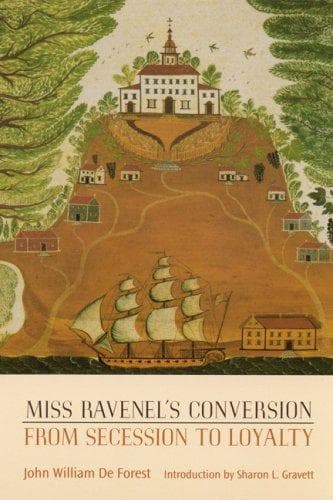
Miss Ravenel's conversion from secession to loyalty — John Shaqi
Miss Ravenel's conversion from secession to loyaltyDe Forest, John William
History
Miss Ravenel's conversion from secession to loyalty
De Forest, John William
Historical fiction; United States -- History -- Civil War, 1861-1865 -- Fiction; War stories; Women -- United States -- Fiction
The dinner lasted an hour and a half, by which time it was nearly
twilight. The ordinary prandial hour of the Whitewoods, as well as of
most fashionable New Boston people, was not later than two o'clock in
the afternoon, but this had been considered a special occasion on
account of the far-off origin of some of the guests, and the meal had
therefore commenced at five. On leaving the table the party went into
the parlor and had coffee. Then Miss Ravenel thought it wise to
propitiate her father's searching eye by quitting the Lieutenant-Colonel
with his pleasant worldly ways and his fascinating masculine maturity,
and going to visit the greenhouse in company with that pale bit of human
celery, John Whitewood. Carter politely stood up to the rack for a while
with Miss Whitewood, but, finding it dry fodder to his taste, soon made
his adieux. Colburne shortly followed, in a state of mind to question
the goodness of Providence in permitting lieutenant-colonels.
CHAPTER III.
MR. COLBURNE TAKES A SEGAR WITH LIEUTENANT-COLONEL CARTER.
As Colburne neared his house he saw the Lieutenant-Colonel standing in
the flare of a street lamp and looking up at the luminary with an air of
puzzled consideration. With a temperance man's usual lack of charity to
people given to wine, the civilian judged that the soldier was
disgracefully intoxicated, and, instead of thinking how to conduct him
quietly home, was about to pass him by on the other side. The
Lieutenant-Colonel turned and recognized the young man. In other states
of feeling he would have cut him there and then, on the ground that it
was not binding on him to continue a chance acquaintance. But being full
at the moment of that comprehensive love of fellow existences which some
constitutions extract from inebriating fluids, he said,
"Ah! how are you? Glad to come across you again."
Colburne nodded, smiled and stopped, saying, "Can I do anything for
you?"
"Will you smoke?" asked the Lieutenant-Colonel, offering a segar. "But
how to light it? there's the rub. I've just broken my last match against
this cursed wet lamp-post--never thought of the dew, you know--and was
studying the machine itself, to see if I could get up to it and into
it."
"I have matches," said Colburne. He produced them; they lighted and
walked on together.
Being a great fancier of good segars, and of moonlit summer walks under
New Boston elms, I should like here to describe how sweetly the
fragrance of the Havanas rose through the still, dewy air into the
interlacing arches of nature's cathedral aisles. The subject would have
its charms, not only for the great multitude of my brother smokers, but
for many young ladies who dearly love the smell of a segar because they
like the creatures who use them. At a later period of this history, if I
see that I am likely to have the necessary space and time, I may bloom
into such pleasant episodes.
Public-domain text, read in full here on John Shaqi.
Reviews
Reviews
No reviews yet
Be the first to share your thoughts on this work.
Join the Discussion
Join the discussion
Sign in to leave a comment or review.
Sign InorCreate an account