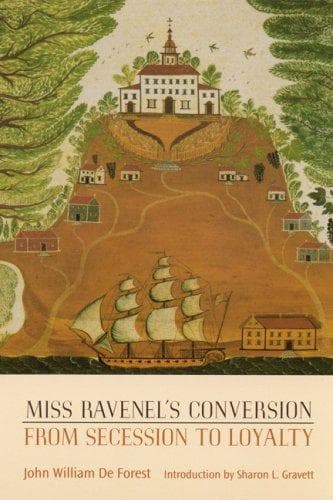
Miss Ravenel's conversion from secession to loyaltyDe Forest, John William
History
Miss Ravenel's conversion from secession to loyalty
De Forest, John William
Historical fiction; United States -- History -- Civil War, 1861-1865 -- Fiction; War stories; Women -- United States -- Fiction
He even thought that the man perceived him, and
supposed that his dangers were over for the present. He was full of
exhilaration, and glanced back at the events of the night with a sense
of satisfaction, taking it all for granted with a resolute faith of
satisfaction, that the Ravenels had escaped. Major Scott was dead; he
was really quite sorry for that; but then two Texans had been killed, or
at least disabled; the war was so much nearer its close. In a small way
he felt much as a general does who has effected a masterly retreat, and
inflicted severe loss upon the pursuing enemy.
Presently a break in the bank forced him to mount the levee. As he
reached the top he stared in astonishment and some dismay at a man in
butternut-colored clothing, mounted on a rough pony, with the
double-barreled gun of Greene's mosstroopers across his saddle-bow, who
was posted on the road not forty feet distant. The Butternut immediately
said, in the pleasant way current in armies, "Halt, you son of a bitch!"
He fired, but missed, as Colburne skirted the break on a run, and sprang
again behind the levee. The Captain then fired in return, with no other
effect than to make the Butternut gallop beyond revolver range. From
this distance he called out, ironically, "I say, Yank, have you heard
from Brashear City?"
Colburne made no reply, but continued his retreat unmolested. When the
sentinel challenged, "Halt! who comes there?" he thought he had never
heard a pleasanter welcome.
"Friend," he answered.
"Halt, friend! Corporal of the guard, number five," shouted the sentry.
The corporal appeared, recognized Colburne, and let him in through the
gate in a palisade which connected one angle of the fort with the river.
The garrison was already under arms, and the men were lying down behind
the low works, with their equipments on and their muskets by their
sides. The first person from the plantation whom Colburne saw was Mauma
Major.
"Where is Mrs. Carter, aunty?" he asked.
"They's all here, bress the Lord! And now you's come!" shouted the good
fat creature, clapping her hands with delight. "Whar my ole man?"
"In heaven," said Colburne, with a solemn tenderness which carried
instant conviction. The woman screamed, and went down upon her knees
with an air and face of such anguish as might cast shame upon those
philosophers as have asserted that the negro is not a man.
"Oh! the Lord gave! The Lord gave!" she repeated, wildly.
Perhaps she had forgotten, perhaps she never knew, the remainder of the
text; but its piteous sense of bereavement, and of more than human
consolation, was evidently clear in some manner to her soul.
CHAPTER XXIII.
CAPTAIN COLBURNE COVERS THE RETREAT OF THE SOUTHERN LABOR ORGANIZATION.
Colburne soon discovered the Ravenels and their retainers bivouacked in
an angle of the fortification. The Doctor actually embraced him in
delight at his escape; and Mrs. Carter seized both his hands in hers,
exclaiming, "Oh, I am so happy!"
Public-domain text, read in full here on John Shaqi.
Reviews
Reviews
No reviews yet
Be the first to share your thoughts on this work.
Elsewhere in the archive
Join the Discussion
Join the discussion
Sign in to leave a comment or review.
Sign InorCreate an account