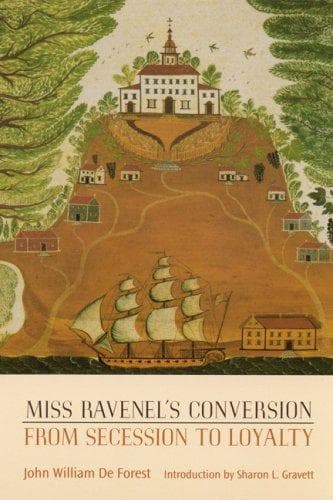
Miss Ravenel's conversion from secession to loyaltyDe Forest, John William
History
Miss Ravenel's conversion from secession to loyalty
De Forest, John William
Historical fiction; United States -- History -- Civil War, 1861-1865 -- Fiction; War stories; Women -- United States -- Fiction
She was full of gayety. She had had a splendid nap; had actually slept
out of doors. Did he see that tent made out of a blanket? She had slept
in that. She could bivouac as well as you, Captain Colburne; she was as
good a soldier as you, Captain Colburne. She liked it, of all things in
the world. She never would sleep in the house again till she was
fif--sixty.
It was curious to note how she checked herself upon the point of
mentioning fifty as the era of first decrepitude. Her father was over
fifty, and therefore fifty could not be old age, notwithstanding her
preconceived opinions on the subject.
"But oh, how obliged we are to you!" she added, changing suddenly to a
serious view. "How kind and noble and brave you are! We owe you so
much!--Isn't it strange that I should be saying such things to you? I
never thought that I should ever say anything of the kind to any man but
my father and my husband. I am indeed grateful to you, and thankful that
you have escaped."
As she spoke, her eyes filled with tears. There was a singular
changeableness about her of late; she shifted rapidly and without
warning, almost without cause, from one emotion to another; she felt and
expressed all emotions with more than usual fervor. She was sadder at
times and gayer at times than circumstances seemed to justify. An
ordinary observer, a man especially, would have been apt to consider
some of her conduct odd, if not irrational. The truth is that she had
been living a new life for the past two months, and that her being,
physical and moral, had not yet been able to settle into a tranquil
unity of function and feeling. Many women and a few men will understand
me here. Colburne was too merely a young man to comprehend anything; but
he could stand a little way off and worship. He thought, as she faced
him with her cheeks flushed and her eyes the brighter for tears, that
she was very near in guise and nature to an angel. It may be a paradox;
it may be a dangerous fact to make public; but he certainly was loving
another man's wife with perfect innocence.
"What is the matter with Mauma Major?" asked the Doctor.
Colburne briefly related the martyrdom of Scott; and father and daughter
hurried to console the weeping black woman.
Public-domain text, read in full here on John Shaqi.
Reviews
Reviews
No reviews yet
Be the first to share your thoughts on this work.
Elsewhere in the archive
Join the Discussion
Join the discussion
Sign in to leave a comment or review.
Sign InorCreate an account