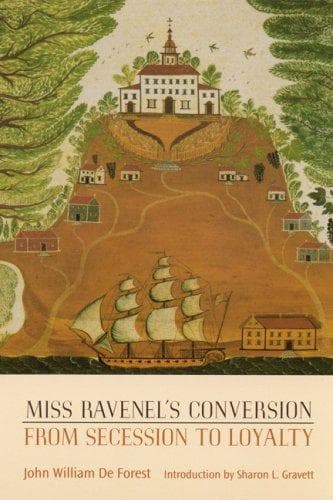
Miss Ravenel's conversion from secession to loyaltyDe Forest, John William
History
Miss Ravenel's conversion from secession to loyalty
De Forest, John William
Historical fiction; United States -- History -- Civil War, 1861-1865 -- Fiction; War stories; Women -- United States -- Fiction
"Come to my room," said the soldier, taking the arm of the civilian.
"Hope you have nothing better to do. We will have a glass of ale."
Colburne would have been glad to refuse. He was modest enough to feel
himself at a disadvantage in the company of men of fashion; and moreover
he was just sufficiently jealous of the Lieutenant-Colonel not to desire
to fraternize with him. Finally, a strong suspicion troubled his mind
that this military personage, indifferent to New Boston opinions, and
evidently a wine-bibber, might proceed to get publicly drunk, thus
making a disagreeable scene, with a chance of future scandal. Why then
did not Colburne decline the invitation? Because he was young,
good-natured, modest, and wanting in that social tact and courage which
most men only acquire by much intercourse with a great variety of their
fellow creatures. The Lieutenant-Colonel's walk was the merest trifle
unsteady, or at least careless, and his herculean arm, solid and
knotted as an apple-tree limb, swayed repeatedly against Colburne,
eliciting from him a stroke-oarsman's approbation. Proud of his own
biceps, the young man had to acknowledge its comparative inferiority in
volume and texture.
"Are you a gymnast, Colonel?" he asked. "Your arm feels like it."
"Sword exercise," answered the other. "Very good thing to work off a
heavy dinner. What do you do here? Boat it, eh? That's better yet, I
fancy."
"But the sword exercise is just the thing for your profession."
"Pshaw!--beg pardon. But do you suppose that we in these times ever
fight hand to hand? No sir. Gunpowder has killed all that."
"Perhaps there never was much real hand to hand fighting," suggested
Colburne. "Look at the battle of Pharsalia. Two armies of Romans, the
best soldiers of antiquity, meet each other, and the defeated party
loses fifteen thousand men killed and wounded, while the victors lose
only about two hundred. Is that fighting? Isn't it clear that Pompey's
men began to run away when they got within about ten feet of Cæsar's?"
"By Jove! you're right. Bully for you! You would make a soldier. Yes.
And if Cæsar's men had had long-range rifles, Pompey's men would have
run away at a hundred yards. All victories are won by moral force--by
the terror of death rather than by death itself."
"Then it is not the big battalions that carry the day," inferred
Colburne. "The weakest battalions will win, if they will stand."
"But they won't stand, by Jove! As soon as they see they are the
weakest, they run away. Modern war is founded on the principle that one
man is afraid of two. Of course you must make allowance for
circumstances, strength of position, fortifications, superior
discipline, and superior leadership. Circumstances are sometimes strong
enough to neutralize numbers.--Look here. Are you interested in these
matters? Why don't you go into the army? What the devil are you staying
at home for when the whole nation is arming, or will soon have to arm?"
Public-domain text, read in full here on John Shaqi.
Reviews
Reviews
No reviews yet
Be the first to share your thoughts on this work.
Join the Discussion
Join the discussion
Sign in to leave a comment or review.
Sign InorCreate an account