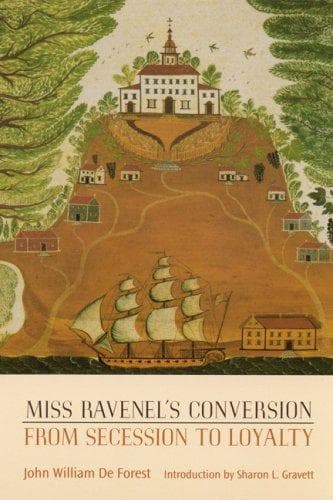
Miss Ravenel's conversion from secession to loyalty — John Shaqi
Miss Ravenel's conversion from secession to loyaltyDe Forest, John William
History
Miss Ravenel's conversion from secession to loyalty
De Forest, John William
Historical fiction; United States -- History -- Civil War, 1861-1865 -- Fiction; War stories; Women -- United States -- Fiction
"What an awful row!" he whispered to Colburne. "I have plunged this
nursery into a state of civil war. When you said pic-nic, how could I
suppose that it was a Sabbath-school excursion? By the way, it isn't
Sunday, is it? Do you always do it this way in New Boston? But you are
not immaculate. You do some things here which would draw down the frown
of society in other places. Look at those couples--a young fellow and a
girl--strolling off by themselves among the thickets. Some of them have
been out of sight for half an hour. I should think it would make talk. I
should think Mrs. Whitewood, who seems to be matron in chief, would stop
it. I tell you, it wouldn't do in New York or Philadelphia, or any such
place, except among the lower classes. You don't catch our young
Louisianienne making a dryad of herself. I heard one of these lads ask
her to take a walk in the grove on top of the hill, and I saw her
decline with a blush which certainly expressed astonishment, and, I
think, indignation. Now how the devil can these old girls, who have
lived long enough to be able to put two and two together, be so dem'd
inconsistent? After regarding me with horror for offering them a glass
of champagne, they will commit imprudences which make them appear as if
they had drunk a bottle of it. And yet, just look. I have too much
delicacy to ask one of those young ones to stroll off with me in the
bushes.--Won't you have a segar? I don't believe Miss Ravenel objects to
tobacco. They smoke in Louisiana; yes, and they chew and drink, too.
Shocking fast set. I really hope the child never will marry down there.
I take an interest in her. You and I will go out there some day, and
reconquer her patrimony, and put her in possession of it, and then ask
her which she will have."
Colburne had already talked a good deal with Miss Ravenel. She was so
discouraging to the student beaux, and Carter had been so general in his
attentions with a view to getting the champagne into circulation, that
she had fallen chiefly to the young lawyer. As to the women, she did not
much enjoy their conversation. At that time everybody at the North was
passionately loyal, especially those who would not in any chance be
called upon to fight--and this loyalty was expressed towards persons of
secessionist proclivities with a frank energy which the latter
considered brutal incivility. From the male sex Miss Ravenel obtained
some compassion or polite forbearance, but from her own very little; and
the result was that she avoided ladies, and might perhaps have been
driven to suffer the boy beaux, only that she could make sure of the
society of Colburne. Important as this young gentleman was to her, she
could not forbear teasing him concerning the local peculiarities of New
Boston. This afternoon she was satirical upon the juvenile gallants.
Public-domain text, read in full here on John Shaqi.
Reviews
Reviews
No reviews yet
Be the first to share your thoughts on this work.
Join the Discussion
Join the discussion
Sign in to leave a comment or review.
Sign InorCreate an account