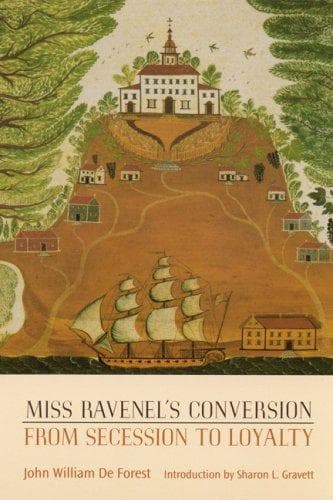
Miss Ravenel's conversion from secession to loyalty — John Shaqi
Miss Ravenel's conversion from secession to loyaltyDe Forest, John William
History
Miss Ravenel's conversion from secession to loyalty
De Forest, John William
Historical fiction; United States -- History -- Civil War, 1861-1865 -- Fiction; War stories; Women -- United States -- Fiction
"You seem to be the only man in New Boston," she said. "I suppose all
the males are executed when they are found guilty of being twenty-one.
How came you to escape? Perhaps you are the executioner. Why don't you
do your office on the Lieutenant-Colonel?"
"I should like to," answered Colburne.
Miss Ravenel colored, but gave no other sign of comprehension.
"I don't like old beaux," persisted Colburne.
"Oh! I do. When I left New Orleans I parted from a beau of forty."
"Forty! How could you come away?"
"Why, you know that I hated to leave New Orleans."
"Yes; but I never knew the reason before. Did you say forty?"
"Yes, sir; just forty. Is there anything strange in a man of forty being
agreeable? I don't see that you New Bostonians find it difficult to like
ladies of forty. But I havn't told you the worst. I have another beau,
whom I like better than anybody, who is fifty-five."
"Your father."
"You are very clever. As you are so bright to-day perhaps you can
explain a mystery to me. Why is it that these grown women are so fond of
the society of these students? They don't seem to care to get a word
from Lieutenant-Colonel Carter. I don't think they are crazy after you.
They are altogether absorbed in making the time pass pleasantly to these
boys."
"It is so in all little university towns. Can't you understand it? When
a girl is fifteen a student is naturally a more attractive object to her
than a mechanic or a shopkeeper's boy. She thinks that to be a student
is the chief end of man; that the world was created in order that there
might be students. Frequently he is a southerner; and you know how
charming southerners are."
"Oh, I know all about it."
"Well, the girl of fifteen takes a fancy to a freshman. She flirts with
him all through the four years of his under-graduate course. Then he
departs, promising to come back, but never keeping his promise. Perhaps
by this time she is really attached to him; and that, or habit, or her
original taste for romance and strangers, gives her a cant for life; she
never flirts with anything but a student afterwards; can't relish a man
who hasn't a flavor of Greek and Latin. Generally she sticks to the
senior class. When she gets into the thirties she sometimes enters the
theological seminary in search of prey. But she never likes anything
which hasn't a student smack. It reminds one of the story that when a
shark has once tasted human flesh he will not eat any other unless
driven to it by hunger."
"What a brutal comparison!"
"One consequence of this fascination," continued Colburne, "is that New
Boston is full of unmarried females. There is a story in college that a
student threw a stone at a dog, and, missing him, hit seven old maids.
On the other hand there are some good results. These old girls are
bookish and mature, and their conversation is improving to the
under-graduates. They sacrifice themselves, as woman's wont is, for the
good of others."
Public-domain text, read in full here on John Shaqi.
Reviews
Reviews
No reviews yet
Be the first to share your thoughts on this work.
Join the Discussion
Join the discussion
Sign in to leave a comment or review.
Sign InorCreate an account