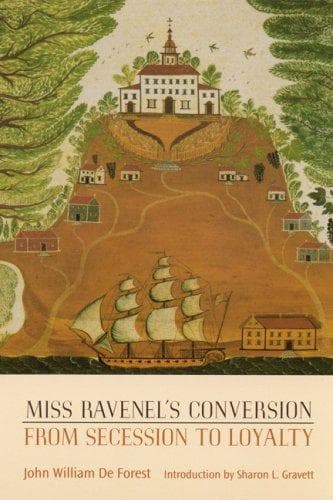
Miss Ravenel's conversion from secession to loyaltyDe Forest, John William
History
Miss Ravenel's conversion from secession to loyalty
De Forest, John William
Historical fiction; United States -- History -- Civil War, 1861-1865 -- Fiction; War stories; Women -- United States -- Fiction
Women and children were as wild with the patriotic excitement as men.
Some of the prettiest and gentlest-born ladies of New Boston waited in a
mixed crowd half the night at the railroad station to see the first
regiments pass towards Washington, and flung their handkerchiefs, rings,
pencil-cases, and other trinkets to the astonished country lads, to show
them how the heart of woman blessed the nation's defenders. In no
society could you be ten minutes without hearing the words war, treason,
rebellion. And so, the subject being every body's subject, the Ravenels
and Colburne frequently talked of it. It was quite a sad and sore
circumstance to the two gentlemen that the lady was a rebel. To a man
who prides himself on his superior capacity and commanding nature, (that
is to say, to almost every man in existence) there can be few greater
grievances than a woman whom he cannot convert; and more particularly
and painfully is this true when she bears some near relationship to him,
as for instance that of a wife, sister, daughter and sweetheart. Thus
Ravenel the father and Colburne the admirer, fretted daily over the
obstinate treasonableness of Miss Lillie. Patriotism she called it,
declaring that Louisiana was her country, and that to it she owed her
allegiance.
It is worthy of passing remark how loyal the young are to the prevailing
ideas of the community in which they are nurtured. You will find adult
republicans in England, but no infant ones; adults monarchists in our
own country, but not in our schools and nurseries. I have known an
American of fifty whose beliefs, prejudices and tastes were all
European, but who could not save his five children from being all
Yankee. Accordingly this young lady of nineteen, born and nurtured among
Louisianians, held firm for Louisiana in spite of the arguments of the
adored papa and the rather agreeable admirer.
The Doctor liked Colburne, and respected his intellect. He rarely tired
of talking with him on any subject, and concerning the war they could go
on interminably. The only point on which they disagreed was the probable
length of the contest; the southerner prophecying that it would last
five or six years, and the northerner that the rebels would succumb in
as many months. Miss Ravenel sometimes said that the North would give up
in a year, and sometimes that the war would last forty years, both of
which opinions she had heard sustained in New Orleans. But, whatever she
said, she always believed in the superior pluck and warlike skill of the
people of her own section.
"Miss Ravenel," said Colburne, "I believe you think that all southerners
are giants, so tall that they can't see a Yankee without lying down, and
so pugnacious that they never go to church without praying for a chance
to fight somebody."
She resented this satire by observing, "Mr. Colburne, if I believe it
you ought not to dispute it."
Public-domain text, read in full here on John Shaqi.
Reviews
Reviews
No reviews yet
Be the first to share your thoughts on this work.
Join the Discussion
Join the discussion
Sign in to leave a comment or review.
Sign InorCreate an account