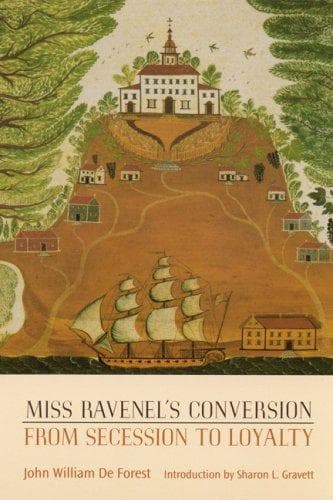
Miss Ravenel's conversion from secession to loyaltyDe Forest, John William
History
Miss Ravenel's conversion from secession to loyalty
De Forest, John William
Historical fiction; United States -- History -- Civil War, 1861-1865 -- Fiction; War stories; Women -- United States -- Fiction
To our young gentleman the civility of this well-bred, middle-aged
personage was somewhat imposing, and consequently he made his best bow
and would not accept of the Post until positively assured that the other
had entirely done with it. Moreover he would not commence reading
immediately because that might seem like a tacit reproach; so he uttered
a few patriotic common-places on the news of the day, and thereby gave
occasion for this history.
"Yes, a sad struggle, a sad struggle--especially for the South,"
assented the unnamed gentleman. "You can't imagine how unprepared they
are for it. The South is just like the town's poor rebelling against the
authorities; the more successful they are, the more sure to be ruined."
While he spoke he looked in the young and strange face of his hearer
with as much seeming earnestness as if the latter had been an old
acquaintance whose opinions were of value to him. There was an amiable
fascination in the sympathetic grey eyes and the persuasive smile. He
caught Colburne's expression of interest and proceeded.
"Nobody can tell me anything about those unlucky, misguided people. I am
one of them by birth--I have lived among them nearly all my life--I know
them. They are as ill-informed as Hottentots. They have no more idea of
their relative strength as compared to that of the United States than
the Root-diggers of the Rocky Mountains. They are doomed to perish by
their own ignorance and madness."
"It will probably be a short struggle," said Colburne, speaking the
common belief of the North.
"I don't know--I don't know about that; we mustn't be too sure of that.
You must understand that they are barbarians, and that all barbarians
are obstinate and reckless. They will hold out like the Florida
Seminoles. They will resist like jackasses and heroes. They won't know
any better. They will be an honor to the fortitude and a sarcasm on the
intelligence of human nature. They will become an example in history of
much that is great, and all that is foolish."
"May I ask what part of the South you have resided in?" inquired
Colburne.
"I am a South Carolinian born. But I have lived in New Orleans for the
last twenty years, summers excepted. A man can't well live there the
year round. He must be away occasionally, to clear his system of its
malaria physical and moral. It is a Sodom. I consider it a proof of
depravity in any one to want to go there. But there was my work, and
there I staid--as little as possible. I staid till this stupid,
barbarous Ashantee rebellion drove me out."
"I am afraid you will be an exile for some time, sir," observed
Colburne, after a short silence during which he regarded the exiled
stranger with patriotic sympathy.
"I am afraid so," was the answer, uttered in a tone which implied
serious reflection if not sadness.
Public-domain text, read in full here on John Shaqi.
Reviews
Reviews
No reviews yet
Be the first to share your thoughts on this work.
Join the Discussion
Join the discussion
Sign in to leave a comment or review.
Sign InorCreate an account