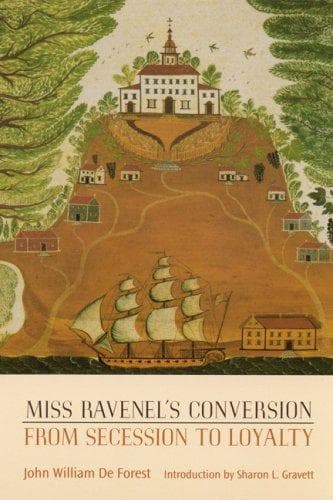
Miss Ravenel's conversion from secession to loyaltyDe Forest, John William
History
Miss Ravenel's conversion from secession to loyalty
De Forest, John William
Historical fiction; United States -- History -- Civil War, 1861-1865 -- Fiction; War stories; Women -- United States -- Fiction
He remembers the lost home, the sacrificed wealth, the undeserved
hostility, the sentence of outlawry which should have been a meed of
honor, thought the enthusiastic young patriot. The voice of welcome
ought to greet him, the hand of friendship ought to aid him, here among
loyal men.
"I hope you stay some time in New Boston, sir," he observed aloud. "If
I can be of the slightest benefit to you, I shall be most happy. Allow
me to offer you my card, sir."
"Oh! Thank you. You are extremely kind," said the stranger. He bowed
very politely and smiled very cordially as he took the bit of
pasteboard; but at the same time there was a slight fixity of surprise
in his eye which made the sensitive Colburne color. He read the name on
the card; then, with a start as of reminiscence, glanced at it again;
then leaned forward and peered into the young man's face with an air of
eager curiosity.
"Are you--is it possible!--are you related to Doctor Edward Colburne of
this place who died fourteen or fifteen years ago?"
"I am his son, sir."
"Is it possible! I am delighted to meet you. I am most sincerely and
earnestly gratified. I knew your father well. I had particular occasion
to know him as a fellow beginner in mineralogy at a time when the
science was little studied in this country. We corresponded and
exchanged specimens. My name is Ravenel. I have been for twenty years
professor of theory and practice in the Medical College of New Orleans.
An excellent place for a dissecting class, by the way. So many negroes
are whipped to death, so many white gentlemen die in their boots, as the
saying is, that we rarely lack for subjects.--But you must have been
quite young when you had the misfortune--and science had the
misfortune--to lose your father. Really, you have quite his look about
the eyes and forehead. What profession may I ask?"
"Law," said Colburne, who was flushed with pleasure over the acquisition
of this charming acquaintance, so evidently to him a man of the world, a
savant, a philosopher, and a patriotic martyr.
"Law--that is a smattering of it--just enough to have an office and do
notary work."
"A good profession! A grand profession! But I should have expected your
father's son to be a physician or a mineralogist."
He took off his spectacles and surveyed Colburne's frank, handsome face
with evidently sincere interest. He seemed as much occupied with this
young stranger's history and prospects as he had been a moment before
with his own beliefs and exile.
At this stage of the conversation one of the hotel servants entered the
room and said, "Sir, the young lady wishes you would come up stairs, if
you please, sir."
"Oh, certainly," answered the stranger, or, as I may now call him, the
Doctor. "Mr. Colburne, come up to my room, if you are at leisure. I
shall be most happy to have a longer conversation with you."
Public-domain text, read in full here on John Shaqi.
Reviews
Reviews
No reviews yet
Be the first to share your thoughts on this work.
Join the Discussion
Join the discussion
Sign in to leave a comment or review.
Sign InorCreate an account