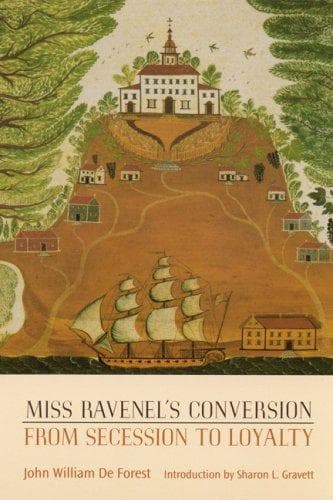
Miss Ravenel's conversion from secession to loyalty — John Shaqi
Miss Ravenel's conversion from secession to loyaltyDe Forest, John William
History
Miss Ravenel's conversion from secession to loyalty
De Forest, John William
Historical fiction; United States -- History -- Civil War, 1861-1865 -- Fiction; War stories; Women -- United States -- Fiction
This story will probably have no readers so destitute of sympathy with
the young and loving, as that they can not guess the result of
Colburne's internal struggles. After two or three chance conversations
with Ravenel he jumped, or to speak more accurately, he gently slid to
the conclusion that it was absurd and unmanly to make a distinction in
favor of the father and against the daughter. Quarrel with a woman; how
ridiculous! how unchivalrous! He colored to the tips of his repentant
ears as he thought of it and of what Miss Ravenel must think of it. He
hastened to call on her before the breach which he had made between her
and himself should become untraversable; for although the embargo on
their intercourse had lasted only about a week, it already seemed to him
a lapse of time measureable by months; and this very naturally, inasmuch
as during that short interval he had lived a life of anguish as a man
and a patriot. Accordingly the old intimacy was resumed, and the two
young people seldom passed forty-eight hours apart. But of the
rebellion they said little, and of Bull Run nothing. These were such
sore subjects to him that he did not wish to speak of them except to the
ear of sympathy; and she, divining his sensitiveness, would not give him
pain notwithstanding that he was an abolitionist and a Yankee. If the
Doctor, ignorant of what passed in these young hearts, turned the
conversation on the war, Lillie became silent, and Colburne,
appreciating her forbearance, tried to say very little. Thus without a
compact, without an explanation, they accorded in a strain of mutual
charity which predicted the ultimate conversion of one or the other.
Moreover, Colburne asked himself, what right had he to talk if he did
not fight? If he wanted to answer this woman's outcry of delight over
the rout of Bull Run, the place to do it was not a safe parlor, but a
field of victorious battle. Why did he not act in accordance with these
truly chivalrous sentiments? Why not fall into one of the new regiments
which his gallant little State was organizing to continue the struggle?
Why not march on with the soul of old John Brown, joining in the sublime
though quaint chorus of, "We're coming, Father Abraham, three hundred
thousand more?"
He did talk very earnestly of it with various persons, and, among
others, with Doctor Ravenel. The latter approved the young man's warlike
inclinations promptly and earnestly.
"It is the noblest duty that you may ever have a chance to perform
during your life," said he. "To do something personally towards
upholding this Union and striking down slavery is an honor beyond any
thing that ever was accorded to Greek or Roman. I wish that I were young
enough for the work, or fitted for it by nature or education. I would be
willing to have my tombstone set up next year, if it could only bear the
inscription, 'He died in giving freedom to slaves.'"
Public-domain text, read in full here on John Shaqi.
Reviews
Reviews
No reviews yet
Be the first to share your thoughts on this work.
Join the Discussion
Join the discussion
Sign in to leave a comment or review.
Sign InorCreate an account