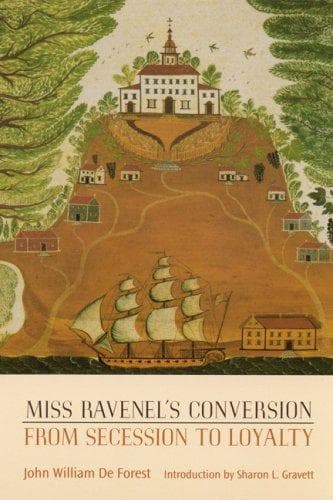
Miss Ravenel's conversion from secession to loyaltyDe Forest, John William
History
Miss Ravenel's conversion from secession to loyalty
De Forest, John William
Historical fiction; United States -- History -- Civil War, 1861-1865 -- Fiction; War stories; Women -- United States -- Fiction
"Oh! do stop," implored Lillie, who entered in time to hear the
concluding sentence. "What do you talk about your tombstone for? You
will get perfectly addled about abolition, like all the rest. Now, papa,
you ought to be more consistent. You didn't use to be so violent against
slavery. You have changed since five years ago."
"I know it," says the Doctor. "But that doesn't prove that I am wrong
now. I wasn't infallible five years ago. Why, my dear, the progress of
our race from barbarism to civilization is through the medium of
constant change. If the race is benefited by it, why not the individual?
I am a sworn foe to consistency and conservation. To stick obstinately
to our old opinions, because they are old, is as foolish as it would be
in a soldier-crab to hold on to his shell after he had outgrown it
instead of picking up a new one fitted to his increased size. Suppose
the snakes persisted in going about in their last year's skins? No, no;
there are no such fools in the lower animal kingdom; that stupidity is
confined to man."
"The world does move," observed Colburne. "We consider ourselves pretty
strict and old-fashioned here in New Boston. But if our Puritan
ancestors could get hold of us, they would be likely to have us whipped
as heretics and Sabbath-breakers. Very likely we would be equally severe
upon our own great-great-grandchildren, if we should get a chance at
them."
"Weak spirits are frightened by this change, this growth, this forward
impetus," said the Doctor. "I must tell you a story. I was travelling in
Georgia three years ago. On the seat next in front of me sat a cracker,
who was evidently making his first railroad experience, and in other
respects learning to go on his hind legs. Presently the train crossed a
bridge. It was narrow, uncovered and without sides, so that a passenger
would not be likely to see it unless he sat near the window. Now the
cracker sat next the alley of the car, and away from the window. I
observed him give a glare at the river and turn away his head suddenly,
after which he rolled about in a queer way, and finally went on the
floor in a heap. We picked him up; spirits were easily produced, (they
always are down there); and presently the cracker was brought to his
senses. His first words were, 'Has she lit'-- He was under the
impression that the train had taken the river at a running jump. Now
that is very much like the judgment of timid and ill-informed people on
the progress of the nation or race at such a time as this. They don't
know about the bridge; they think we are flying through the air; and so
they go off in general fainting-fits."
Colburne laughed, as many another man has done before him, at this good
old story.
Public-domain text, read in full here on John Shaqi.
Reviews
Reviews
No reviews yet
Be the first to share your thoughts on this work.
Join the Discussion
Join the discussion
Sign in to leave a comment or review.
Sign InorCreate an account