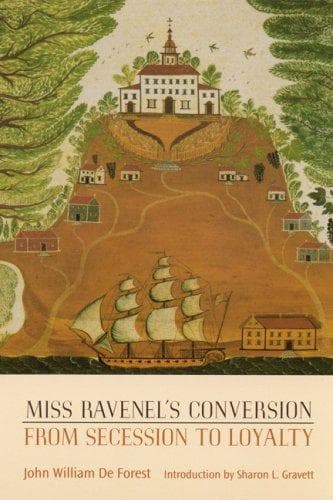
Miss Ravenel's conversion from secession to loyaltyDe Forest, John William
History
Miss Ravenel's conversion from secession to loyalty
De Forest, John William
Historical fiction; United States -- History -- Civil War, 1861-1865 -- Fiction; War stories; Women -- United States -- Fiction
The question still returns upon us, why Mr. Colburne did not join the
army. It is time, therefore, to state the hitherto unimportant fact that
he was the only son of a widow, and that his life was a necessity to
her, not only as a consolation to her loneliness, but as a support to
her declining fortunes. Doctor Colburne had left his wife and child an
estate of about twenty-five thousand dollars, which at the time of his
death was a respectable fortune in New Boston. But the influx of gold
from California, and the consequent rise of prices, seriously diminished
the value of the family income just about the time that Edward, by
growing into manhood and entering college, necessitated an increase of
expenses. Therefore Mrs. Colburne was led to put one half of the joint
fortune into certain newly-organized manufacturing companies, which
promised to increase her annual six per cent to twenty-four--nor was she
therein exceedingly to blame, being led away by the example and advice
of some of the sharpest New Boston capitalists, many of whom had their
experienced pinions badly lamed in these joint-stock adventurings.
"What you want, Mr. Colburne," said a director, "is an investment which
is both safe and permanent. Now this is just the thing."
I can not say much for the safety of the investment, but it certainly
was a permanent one. During the first year the promised twenty-four per
cent was paid, and the widow could have sold out for one hundred and
twenty. Then came a free-trade, Democratic improvement on the tariff;
the manufacturing interest of the country was paralyzed, and the
Braggville stock fell to ninety. Mrs. Colburne might still have sold
out at a profit, counting in her first year's dividend; but as it was
not in her inexperience to see that this was wisdom, she held on for
a--decline. By the opening of the war her certificates of manufacturing
stock were waste paper, and her annual income was reduced to eight
hundred dollars. Indeed, for a year or two previous to the commencement
of this story, she had been forced to make inroads upon her capital.
Of this crisis in the family affairs Edward was fully aware, and like a
true-born, industrious Yankee, did his best to meet it. From every
lowermost branch and twig of his profession he plucked some fruit by
dint of constant watchfulness, so that during the past year he had been
very nearly able to cover his own conscientiously economical
expenditures. He was gaining a foothold in the law, although he as yet
had no cases to plead. If he held on a year or two longer at this rate
he might confidently expect to restore the family income and stave off
the threatened sale of the homestead.
Public-domain text, read in full here on John Shaqi.
Reviews
Reviews
No reviews yet
Be the first to share your thoughts on this work.
Join the Discussion
Join the discussion
Sign in to leave a comment or review.
Sign InorCreate an account