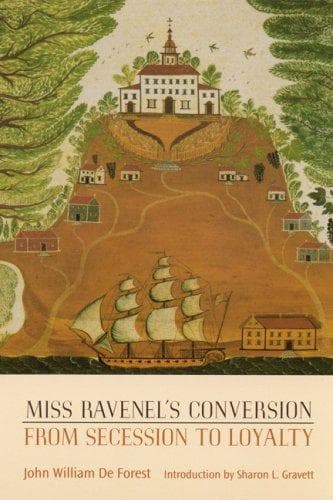
Miss Ravenel's conversion from secession to loyalty — John Shaqi
Miss Ravenel's conversion from secession to loyaltyDe Forest, John William
History
Miss Ravenel's conversion from secession to loyalty
De Forest, John William
Historical fiction; United States -- History -- Civil War, 1861-1865 -- Fiction; War stories; Women -- United States -- Fiction
But this was not all which prevented him from going forth to battle. The
cry of his mother's heart was, "My son, how can I let thee go?" She was
an abolitionist, as was almost every body of her set in New Boston; she
was an enthusiastic patriot, as was almost every one in the north during
that sublime summer of popular enthusiasm; but this war--oh, this
strange, ferocious war! was horrible. Her sensitively affectionate
nature, blinded by veils of womanly tenderness, folded in habits of
life-long peace, could not see the hard, inevitable necessity of the
contest. Earnestly as she sympathised with its loyal and humane objects,
she was not logical enough or not firm enough to sympathise with the
iron thing itself. Lapped in sweet influences of peace all her loving
life, why must she be called to death amid the clamor of murderous
contests? For her health was failing; a painful and fatal disease had
fastened its clutches on her; another year's course she did not hope to
run. And if the hateful struggle must go on, if it must torment her
last few days with its agitations and horrors, so much the more did she
need her only child. Other women's sons--yes, if there was no help for
it--but not hers--might put on the panoply of strife, and disappear from
anxiously following eyes into the smoke and flame of battle. Edward told
her every day the warlike news of the journals, the grand and stern
putting on of the harness, the gigantic plans for crushing the nation's
foes. She could take no interest in such tidings but that of aversion.
He read to her in a voice which thrilled like swellings of martial
music, Tennyson's Charge of the Six Hundred. She listened to the
clarion-toned words with distaste and almost with horror.
Well, the summer wore away, that summer of sombre preparation and
preluding skirmishes, whose scattering musketry and thin cannonade
faintly prophecied the orchestral thunders of Gettysburg and the
Wilderness, and whose few dead preceded like skirmishers the massive
columns which for years should firmly follow them into the dark valley.
Its forereaching shadows fell upon many homes far away from the
battlefield, and chilled to death many sensitive natures. Old persons
and invalids sank into the grave that season under the oppression of its
straining suspense and preliminary horror; and among these victims, whom
no man has counted and whom few have thought of collectively, was the
mother of Colburne.
Public-domain text, read in full here on John Shaqi.
Reviews
Reviews
No reviews yet
Be the first to share your thoughts on this work.
Join the Discussion
Join the discussion
Sign in to leave a comment or review.
Sign InorCreate an account