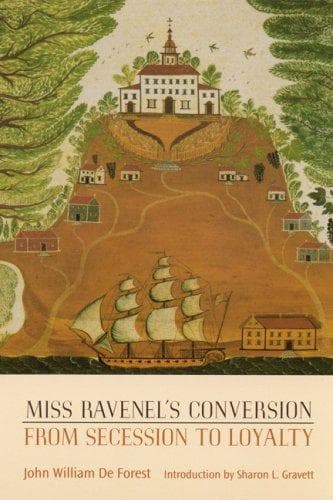
Miss Ravenel's conversion from secession to loyaltyDe Forest, John William
History
Miss Ravenel's conversion from secession to loyalty
De Forest, John William
Historical fiction; United States -- History -- Civil War, 1861-1865 -- Fiction; War stories; Women -- United States -- Fiction
Colburne was in the usual quandary of young and modest men on such
occasions. He wished to accept the invitation; he feared that he ought
not to take advantage of it; he did not know how to decline it. After a
lightning-like consideration of the _pros_ and _cons_, after a stealthy
glance at his toilet in the mirror, he showed the good sense and had the
good luck to follow Doctor Ravenel to his private parlor. As they
entered, the same silver voice which Colburne had heard below,
exclaimed, "Why papa! What has kept you so long? I have been as lonely
as a mouse in a trap."
"Lillie, let me introduce Mr. Colburne to you," answered papa. "My dear
sir, take this arm chair. It is much more comfortable than those awkward
mahogany uprights. Don't suppose that I want it. I prefer the sofa, I
really do."
Miss Ravenel, I suppose I ought to state in this exact place, was very
fair, with lively blue eyes and exceedingly handsome hair, very
luxuriant, very wavy and of a flossy blonde color lighted up by flashes
of amber. She was tall and rather slender, with a fine form and an
uncommon grace of manner and movement. Colburne was flattered by the
quick blush and pretty momentary flutter of embarrassment with which she
received him. This same irrepressible blush and flutter often interested
those male individuals who were fortunate enough to make Miss Ravenel's
acquaintance. Each young fellow thought that she was specially
interested in himself; that the depths of her womanly nature were
stirred into pleasurable excitement by his advent. And it was frequently
not altogether a mistake. Miss Ravenel was interested in people, in a
considerable number of people, and often at first sight. She had her
father's sympathetic character, as well as his graceful cordiality and
consequent charm of manner, the whole made more fascinating by being
veiled in a delicate gauze of womanly dignity. As to her being as lovely
as a houri, I confess that there were different opinions on that
question, and I do not care to settle it, as I of course might, by a
tyrannical affirmation.
It is curious how resolutely most persons demand that the heroine of a
story shall be extraordinarily handsome. And yet the heroine of many a
love affair in our own lives is not handsome; and most of us fall in
love, quite earnestly and permanently in love too, with rather plain
women. Why then should I strain my conscience by asserting broadly and
positively that Miss Ravenel was a first class beauty? But I do affirm
without hesitation that, like her father, she was socially charming. I
go farther: she was also very loveable and (I beg her pardon) very
capable of loving; although up to this time she did not feel sure that
she possessed either of these two qualities.
Public-domain text, read in full here on John Shaqi.
Reviews
Reviews
No reviews yet
Be the first to share your thoughts on this work.
Join the Discussion
Join the discussion
Sign in to leave a comment or review.
Sign InorCreate an account