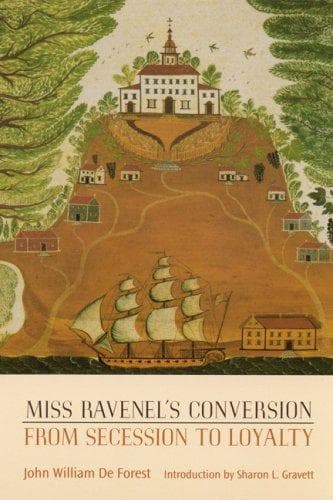
Miss Ravenel's conversion from secession to loyalty — John Shaqi
Miss Ravenel's conversion from secession to loyaltyDe Forest, John William
History
Miss Ravenel's conversion from secession to loyalty
De Forest, John William
Historical fiction; United States -- History -- Civil War, 1861-1865 -- Fiction; War stories; Women -- United States -- Fiction
"I had to take sides. Those unhappy Chinese allow no neutrals--nothing
but themselves, the central flowery people, and outside barbarians. They
have fed on the poor blacks until they can't abide a man who isn't a
cannibal. He is a reproach to them, and they must make away with him.
They remind me of a cracker whom I met at a cross road tavern in one of
my journeys through the north of Georgia. This man, a red-nosed,
tobacco-drizzling, whiskey-perfumed giant, invited me to drink with
him, and, when I declined, got furious and wanted to fight me. I told
him that I never drank whiskey and that it made me sick, and finally
succeeded in pacifying him without touching his poison. In fact he made
me a kind of apology for having offered to cut my throat. 'Wa'al, fact
is, stranger,' said he, '_I_,' (laying an accent as strong as his liquor
on the personal pronoun) '_I_ use whiskey.'--You understand the
inference, I suppose: a man who refused whiskey was a contradiction, a
reproach to his personality: such a man he could not suffer to live. It
was the Brooks and Sumner affair over again. Brooks says, 'Fact is _I_
believe in slavery,' and immediately hits Sumner over the head for not
believing in it."
"Something like my grandfather, who, when he had to diet, used to want
the whole family to live on dry toast," observed Colburne. "For the time
being he believed in the universal propriety and necessity of toast."
"Were you in danger of violence before you left New Orleans?" he
presently asked. "I beg pardon if I am too curious."
"Violence? Why, not precisely; not immediate violence. The breaking-off
point was this. I must explain that I dabble in chemistry as well as
mineralogy. Now in all that city of raw materialism, of cotton-bale and
sugar-hogshead instinct--I can't call it intelligence--there was not a
man of southern principles who knew enough of chemistry to make a fuse.
They wanted to possess themselves of the United States forts in their
State. They supposed that they would be obliged to shell them. The
shells they had plundered from the United States arsenal; but the fuses
were wanting. A military committee requested me to fabricate them. Of
course I was driven to make an immediate choice between rebellion and
loyalty. I took the first steamboat to New York, getting off just in
time to escape the system of surveillance which the vigilance committees
established."
Public-domain text, read in full here on John Shaqi.
Reviews
Reviews
No reviews yet
Be the first to share your thoughts on this work.
Join the Discussion
Join the discussion
Sign in to leave a comment or review.
Sign InorCreate an account