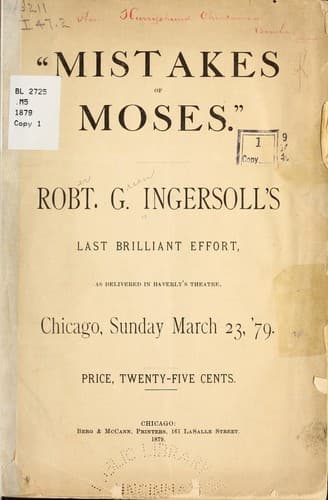
Moses differed from most of the makers of sacred books by his failure
to say anything of a future life, by failing to promise heaven, and to
threaten hell. Upon the subject of a future state, there is not one
word in the Pentateuch. Probably at that early day God did not deem
it important to make a revelation as to the eternal destiny of man.
He seems to have thought that he could control the Jews, at least, by
rewards and punishments in this world, and so he kept the frightful
realities of eternal joy and torment a profound secret from the people
of his choice. He thought it far more important to tell the Jews their
origin than to enlighten them as to their destiny.
We must remember that every tribe and nation has some way in which, the
more striking phenomena of nature are accounted for. These accounts
are handed down by tradition, changed by numberless narrators as
intelligence increases, or to account for newly discovered facts, or for
the purpose of satisfying the appetite for the marvelous.
The way in which a tribe or nation accounts for day and night, the
change of seasons, the fall of snow and rain, the flight of birds,
the origin of the rainbow, the peculiarities of animals, the dreams
of sleep, the visions of the insane, the existence of earthquakes,
volcanoes, storms, lightning and the thousand things that attract the
attention and excite the wonder, fear or admiration of mankind, may be
called the philosophy of that tribe or nation. And as all phenomena are,
by savage and barbaric man accounted for as the action of intelligent
beings for the accomplishment of certain objects, and as these beings
were supposed to have the power to assist or injure man, certain things
were supposed necessary for man to do in order to gain the assistance,
and avoid the anger of these gods. Out of this belief grew certain
ceremonies, and these ceremonies united with the belief, formed
religion; and consequently every religion has for its foundation a
misconception of the cause of phenomena.
All worship is necessarily based upon the belief that some being exists
who can, if he will, change the natural order of events. The savage
prays to a stone that he calls a god, while the christian prays to a god
that he calls a spirit, and the prayers of both are equally useful. The
savage and the christian put behind the Universe an intelligent cause,
and this cause whether represented by one god or many, has been, in all
ages, the object of all worship. To carry a fetich, to utter a prayer,
to count beads, to abstain from food, to sacrifice a lamb, a child or an
enemy, are simply different ways by which the accomplishment of the same
object is sought, and are all the offspring of the same error.
Public-domain text, read in full here on John Shaqi.
Reviews
Reviews
No reviews yet
Be the first to share your thoughts on this work.
Join the Discussion
Join the discussion
Sign in to leave a comment or review.
Sign InorCreate an account