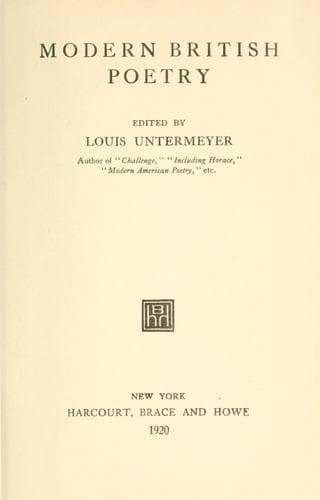
English poetry -- 19th century; English poetry -- 20th century
New tendencies are contagious. But they also disclose themselves
simultaneously in places and people where there has been no point of
contact. Even before Synge published his proofs of the keen poetry in
everyday life, Kipling was illuminating, in a totally different
manner, the wealth of poetic material in things hitherto regarded as
too commonplace for poetry. Before literary England had quite
recovered from its surfeit of Victorian priggishness and
pre-Raphaelite delicacy, Kipling came along with high spirits and a
great tide of life, sweeping all before him. An obscure Anglo-Indian
journalist, the publication of his _Barrack-room Ballads_ in 1892
brought him sudden notice. By 1895 he was internationally famous.
Brushing over the pallid attempts to revive a pallid past, he rode
triumphantly on a wave of buoyant and sometimes brutal joy in the
present. Kipling gloried in the material world; he did more--he
glorified it. He pierced the coarse exteriors of seemingly prosaic
things--things like machinery, bridge-building, cockney soldiers,
slang, steam, the dirty by-products of science (witness "M'Andrews
Hymn" and "The Bell Buoy")--and uncovered their hidden glamour.
"Romance is gone," sighed most of his contemporaries,
"... and all unseen
Romance brought up the nine-fifteen."
That sentence (from his poem "The King") contains the key to the
manner in which the author of _The Five Nations_ helped to rejuvenate
English verse.
Kipling, with his perception of ordinary people in terms of ordinary
life, was one of the strongest links between the Wordsworth-Browning
era and the latest apostles of vigor, beginning with Masefield. There
are occasional and serious defects in Kipling's work--particularly in
his more facile poetry; he falls into a journalistic ease that tends
to turn into jingle; he is fond of a militaristic drum-banging that is
as blatant as the insularity he condemns. But a burning, if sometimes
too simple faith, shines through his achievements. His best work
reveals an intensity that crystallizes into beauty what was originally
tawdry, that lifts the vulgar and incidental to the place of the
universal.
JOHN MASEFIELD
Public-domain text, read in full here on John Shaqi.
Reviews
Reviews
No reviews yet
Be the first to share your thoughts on this work.
Join the Discussion
Join the discussion
Sign in to leave a comment or review.
Sign InorCreate an account