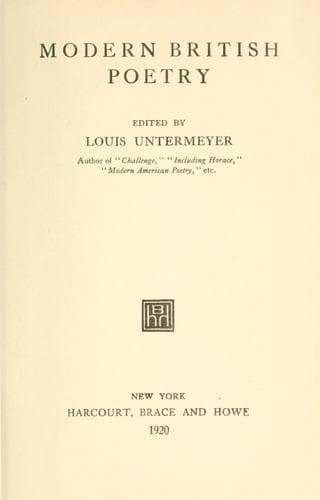
English poetry -- 19th century; English poetry -- 20th century
All art is a twofold revivifying--a recreation of subject and a
reanimating of form. And poetry becomes perennially "new" by returning
to the old--with a different consciousness, a greater awareness. In
1911, when art was again searching for novelty, John Masefield created
something startling and new by going back to 1385 and _The Canterbury
Pilgrims_. Employing both the Chaucerian model and a form similar to
the practically forgotten Byronic stanza, Masefield wrote in rapid
succession, _The Everlasting Mercy_ (1911), _The Widow in the Bye
Street_ (1912), _Dauber_ (1912), _The Daffodil Fields_ (1913)--four
astonishing rhymed narratives and four of the most remarkable poems
of our generation. Expressive of every rugged phase of life, these
poems, uniting old and new manners, responded to Synge's proclamation
that "the strong things of life are needed in poetry also ... and it
may almost be said that before verse can be human again it must be
brutal."
Masefield brought back to poetry that mixture of beauty and brutality
which is its most human and enduring quality. He brought back that
rich and almost vulgar vividness which is the very life-blood of
Chaucer, of Shakespeare, of Burns, of Villon, of Heine--and of all
those who were not only great artists but great humanists. As a purely
descriptive poet, he can take his place with the masters of sea and
landscape. As an imaginative realist, he showed those who were
stumbling from one wild eccentricity to another to thrill them, that
they themselves were wilder, stranger, far more thrilling than
anything in the world--or out of it. Few things in contemporary poetry
are as powerful as the regeneration of Saul Kane (in _The Everlasting
Mercy_) or the story of _Dauber_, the tale of a tragic sea-voyage and
a dreaming youth who wanted to be a painter. The vigorous description
of rounding Cape Horn in the latter poem is superbly done, a
masterpiece in itself. Masefield's later volumes are quieter in tone,
more measured in technique; there is an almost religious ring to many
of his Shakespearian sonnets. But the swinging surge is there, a
passionate strength that leaps through all his work from _Salt Water
Ballads_ (1902) to _Reynard the Fox_ (1919).
"THE GEORGIANS" AND THE YOUNGER MEN
Public-domain text, read in full here on John Shaqi.
Reviews
Reviews
No reviews yet
Be the first to share your thoughts on this work.
Join the Discussion
Join the discussion
Sign in to leave a comment or review.
Sign InorCreate an account