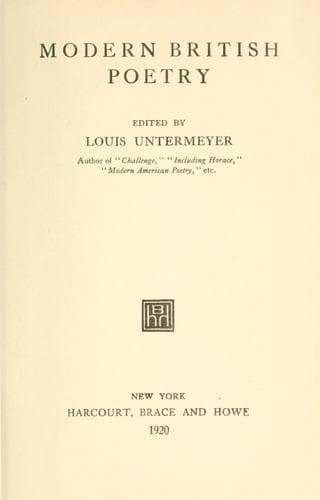
English poetry -- 19th century; English poetry -- 20th century
There is no sharp statistical line of demarcation between Masefield
and the younger men. Although several of them owe much to him, most of
the younger poets speak in accents of their own. W. W. Gibson had
already reinforced the "return to actuality" by turning from his first
preoccupation with shining knights, faultless queens, ladies in
distress and all the paraphernalia of hackneyed mediaeval romances, to
write about ferrymen, berry-pickers, stone-cutters, farmers, printers,
circus-men, carpenters--dramatizing (though sometimes theatricalizing)
the primitive emotions of uncultured and ordinary people in
_Livelihood_, _Daily Bread_ and _Fires_. This intensity had been
asking new questions. It found its answers in the war; repressed
emotionalism discovered a new outlet. One hears its echoes in the
younger poets like Siegfried Sassoon, with his poignant and unsparing
poems of conflict; in Robert Graves, who reflects it in a lighter and
more fantastic vein; in James Stephens, whose wild ingenuities are
redolent of the soil. And it finds its corresponding opposite in the
limpid and unperturbed loveliness of Ralph Hodgson; in the ghostly
magic and the nursery-rhyme whimsicality of Walter de la Mare; in the
quiet and delicate lyrics of W. H. Davies. Among the others, the
brilliant G. K. Chesterton, the facile Alfred Noyes, the romantic
Rupert Brooke (who owes less to Masefield and his immediate
predecessors than he does to the passionately intellectual Donne), the
introspective D. H. Lawrence and the versatile J. C. Squire, are
perhaps best known to American readers.
All of the poets mentioned in the foregoing paragraph (with the
exception of Noyes) have formed themselves in a loose group called
"The Georgians," and an anthology of their best work has appeared
every two years since 1913. Masefield, Lascelles Abercrombie and John
Drinkwater are also listed among the Georgian poets. When their first
collection appeared in March, 1913, Henry Newbolt, a critic as well as
poet, wrote: "These younger poets have no temptation to be false. They
are not for making something 'pretty,' something up to the standard of
professional patterns.... They write as grown men walk, each with his
own unconscious stride and gesture.... In short, they express
themselves and seem to steer without an effort between the dangers of
innovation and reminiscence." The secret of this success, and for that
matter, the success of the greater portion of English poetry, is not
an exclusive discovery of the Georgian poets. It is their inheritance,
derived from those predecessors who, "from Wordsworth and Coleridge
onward, have worked for the assimilation of verse to the manner and
accent of natural speech." In its adaptability no less than in its
vigor, modern English poetry is true to its period--and its past.
* * * * *
Public-domain text, read in full here on John Shaqi.
Reviews
Reviews
No reviews yet
Be the first to share your thoughts on this work.
Join the Discussion
Join the discussion
Sign in to leave a comment or review.
Sign InorCreate an account