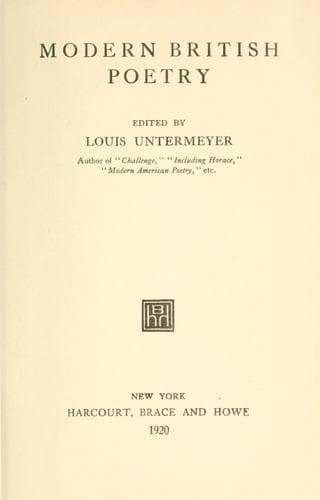
English poetry -- 19th century; English poetry -- 20th century
Time was when 'mid the maidens you would pull
The fiery raisin with profound delight;
When sprigs of mistletoe seemed beautiful
And right.
Old Christmas changes not! Long, long ago
He won the treasure of eternal youth;
_Yours_ is the dotage--if you want to know
The truth.
Come, now, I'll cure your case, and ask no fee:--
Make others' happiness this once your own;
All else may pass: that joy can never be
Outgrown!
THOMAS OF THE LIGHT HEART
Facing the guns, he jokes as well
As any Judge upon the Bench;
Between the crash of shell and shell
His laughter rings along the trench;
He seems immensely tickled by a
Projectile while he calls a "Black Maria."
He whistles down the day-long road,
And, when the chilly shadows fall
And heavier hangs the weary load,
Is he down-hearted? Not at all.
'Tis then he takes a light and airy
View of the tedious route to Tipperary.[4]
His songs are not exactly hymns;
He never learned them in the choir;
And yet they brace his dragging limbs
Although they miss the sacred fire;
Although his choice and cherished gems
Do not include "The Watch upon the Thames."
He takes to fighting as a game;
He does no talking, through his hat,
Of holy missions; all the same
He has his faith--be sure of that;
He'll not disgrace his sporting breed,
Nor play what isn't cricket. There's his creed.
FOOTNOTES:
[4] "_It's a long way to Tipperary_," the most popular song of the
Allied armies during the World's War.
_Henry Newbolt_
Henry Newbolt was born at Bilston in 1862. His early work was frankly
imitative of Tennyson; he even attempted to add to the Arthurian
legends with a drama in blank verse entitled _Mordred_ (1895). It was
not until he wrote his sea-ballads that he struck his own note. With
the publication of _Admirals All_ (1897) his fame was widespread. The
popularity of his lines was due not so much to the subject-matter of
Newbolt's verse as to the breeziness of his music, the solid beat of
rhythm, the vigorous swing of his stanzas.
In 1898 Newbolt published _The Island Race_, which contains about
thirty more of his buoyant songs of the sea. Besides being a poet,
Newbolt has written many essays and his critical volume, _A New Study
of English Poetry_ (1917), is a collection of articles that are both
analytical and alive.
DRAKE'S DRUM
Drake he's in his hammock an' a thousand mile away,
(Capten, art tha sleepin' there below?)
Slung atween the round shot in Nombre Dios Bay,
An' dreamin' arl the time o' Plymouth Hoe.
Yarnder lumes the island, yarnder lie the ships,
Wi' sailor lads a-dancin' heel-an'-toe,
An' the shore-lights flashin', an' the night-tide dashin'
He sees et arl so plainly as he saw et long ago.
Public-domain text, read in full here on John Shaqi.
Reviews
Reviews
No reviews yet
Be the first to share your thoughts on this work.
Join the Discussion
Join the discussion
Sign in to leave a comment or review.
Sign InorCreate an account