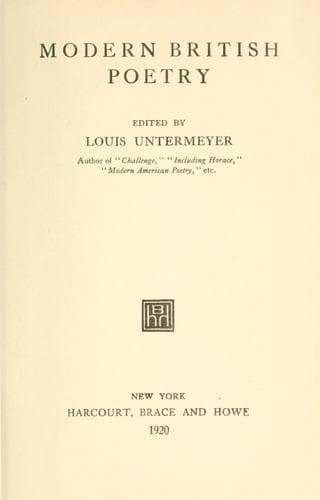
English poetry -- 19th century; English poetry -- 20th century
Drake he was a Devon man, an' ruled the Devon seas,
(Capten, art tha sleepin' there below?),
Rovin' tho' his death fell, he went wi' heart at ease,
An' dreamin' arl the time o' Plymouth Hoe,
"Take my drum to England, hang et by the shore,
Strike et when your powder's runnin' low;
If the Dons sight Devon, I'll quit the port o' Heaven,
An' drum them up the Channel as we drummed them long ago."
Drake he's in his hammock till the great Armadas come,
(Capten, art tha sleepin' there below?),
Slung atween the round shot, listenin' for the drum,
An' dreamin' arl the time o' Plymouth Hoe.
Call him on the deep sea, call him up the Sound,
Call him when ye sail to meet the foe;
Where the old trade's plyin' an' the old flag flyin',
They shall find him, ware an' wakin', as they found him long ago.
_Arthur Symons_
Born in 1865, Arthur Symons' first few publications revealed an
intellectual rather than an emotional passion. Those volumes were full
of the artifice of the period, but Symons's technical skill and
frequent analysis often saved the poems from complete decadence. His
later books are less imitative; the influence of Verlaine and
Baudelaire is not so apparent; the sophistication is less cynical, the
sensuousness more restrained. His various collections of essays and
stories reflect the same peculiar blend of rich intellectuality and
perfumed romanticism that one finds in his most characteristic poems.
Of his many volumes in prose, _Spiritual Adventures_ (1905), while
obviously influenced by Walter Pater, is by far the most original; a
truly unique volume of psychological short stories. The best of his
poetry up to 1902 was collected in two volumes, _Poems_, published by
John Lane Co. _The Fool of the World_ appeared in 1907.
IN THE WOOD OF FINVARA
I have grown tired of sorrow and human tears;
Life is a dream in the night, a fear among fears,
A naked runner lost in a storm of spears.
I have grown tired of rapture and love's desire;
Love is a flaming heart, and its flames aspire
Till they cloud the soul in the smoke of a windy fire.
I would wash the dust of the world in a soft green flood;
Here between sea and sea, in the fairy wood,
I have found a delicate, wave-green solitude.
Here, in the fairy wood, between sea and sea,
I have heard the song of a fairy bird in a tree,
And the peace that is not in the world has flown to me.
MODERN BEAUTY
I am the torch, she saith, and what to me
If the moth die of me? I am the flame
Of Beauty, and I burn that all may see
Beauty, and I have neither joy nor shame,
But live with that clear light of perfect fire
Which is to men the death of their desire.
Public-domain text, read in full here on John Shaqi.
Reviews
Reviews
No reviews yet
Be the first to share your thoughts on this work.
Join the Discussion
Join the discussion
Sign in to leave a comment or review.
Sign InorCreate an account