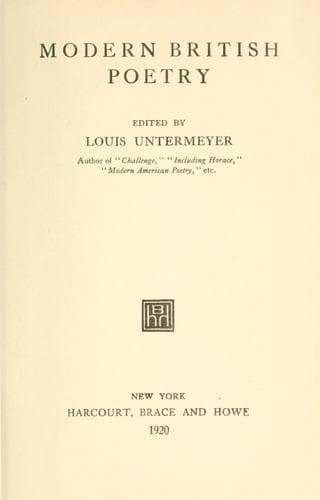
English poetry -- 19th century; English poetry -- 20th century
I am Yseult and Helen, I have seen
Troy burn, and the most loving knight lie dead.
The world has been my mirror, time has been
My breath upon the glass; and men have said,
Age after age, in rapture and despair,
Love's poor few words, before my image there.
I live, and am immortal; in my eyes
The sorrow of the world, and on my lips
The joy of life, mingle to make me wise;
Yet now the day is darkened with eclipse:
Who is there still lives for beauty? Still am I
The torch, but where's the moth that still dares die?
_William Butler Yeats_
Born at Sandymount, Dublin, in 1865, the son of John B. Yeats, the
Irish artist, the greater part of William Butler Yeats' childhood was
spent in Sligo. Here he became imbued with the power and richness of
native folk-lore; he drank in the racy quality through the quaint
fairy stories and old wives' tales of the Irish peasantry. (Later he
published a collection of these same stories.)
It was in the activities of a "Young Ireland" society that Yeats
became identified with the new spirit; he dreamed of a national poetry
that would be written in English and yet would be definitely Irish. In
a few years he became one of the leaders in the Celtic revival. He
worked incessantly for the cause, both as propagandist and playwright;
and, though his mysticism at times seemed the product of a cult rather
than a Celt, his symbolic dramas were acknowledged to be full of a
haunting, other-world spirituality. (See Preface.) _The Hour Glass_
(1904), his second volume of "Plays for an Irish Theatre," includes
his best one-act dramas with the exception of his unforgettable _The
Land of Heart's Desire_ (1894). _The Wind Among the Reeds_ (1899)
contains several of his most beautiful and characteristic poems.
Others who followed Yeats have intensified the Irish drama; they have
established a closer contact between the peasant and poet. No one,
however, has had so great a part in the shaping of modern drama in
Ireland as Yeats. His _Deirdre_ (1907), a beautiful retelling of the
great Gaelic legend, is far more dramatic than the earlier plays; it
is particularly interesting to read with Synge's more idiomatic play
on the same theme, _Deirdre of the Sorrows_.
The poems of Yeats which are quoted here reveal him in his most lyric
and musical vein.
THE LAKE ISLE OF INNISFREE
I will arise and go now, and go to Innisfree,
And a small cabin build there, of clay and wattles made;
Nine bean rows will I have there, a hive for the honey bee,
And live alone in the bee-loud glade.
And I shall have some peace there, for peace comes dropping slow,
Dropping from the veils of the morning to where the cricket sings;
There midnight's all a glimmer, and noon a purple glow,
And evening full of the linnet's wings.
Public-domain text, read in full here on John Shaqi.
Reviews
Reviews
No reviews yet
Be the first to share your thoughts on this work.
Join the Discussion
Join the discussion
Sign in to leave a comment or review.
Sign InorCreate an account