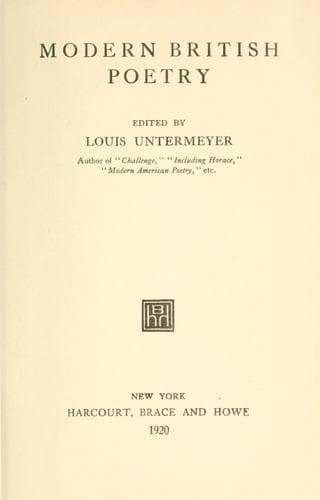
English poetry -- 19th century; English poetry -- 20th century
_The Yellow Book_, the organ of a group of young writers and artists,
appeared (1894-97), representing a reasoned and intellectual reaction,
mainly suggested and influenced by the French. The group of
contributors was a peculiarly mixed one with only one thing in common.
And that was a conscious effort to repudiate the sugary airs and prim
romantics of the Victorian Era.
Almost the first act of the "new" men was to rouse and outrage their
immediate predecessors. This end-of-the-century desire to shock,
which was so strong and natural an impulse, still has a place of its
own--especially as an antidote, a harsh corrective. Mid-Victorian
propriety and self-satisfaction crumbled under the swift and energetic
audacities of the sensational younger authors and artists; the old
walls fell; the public, once so apathetic to _belles lettres_, was
more than attentive to every phase of literary experimentation. The
last decade of the nineteenth century was so tolerant of novelty in
art and ideas, that it would seem, says Holbrook Jackson in his
penetrative summary, _The Eighteen-Nineties_, "as though the declining
century wished to make amends for several decades of artistic
monotony. It may indeed be something more than a coincidence that
placed this decade at the close of a century, and _fin de siecle_ may
have been at once a swan song and a death-bed repentance."
But later on, the movement (if such it may be called), surfeited with
its own excesses, fell into the mere poses of revolt; it degenerated
into a half-hearted defense of artificialities.
It scarcely needed W. S. Gilbert (in _Patience_) or Robert Hichens (in
_The Green Carnation_) to satirize its distorted attitudinizing. It
strained itself to death; it became its own burlesque of the bizarre,
an extravaganza of extravagance. "The period" (I am again quoting
Holbrook Jackson) "was as certainly a period of decadence as it was a
period of renaissance. The decadence was to be seen in a perverse and
finicking glorification of the fine arts and mere artistic virtuosity
on the one hand, and a militant commercial movement on the other....
The eroticism which became so prevalent in the verse of many of the
younger poets was minor because it was little more than a pose--not
because it was erotic.... It was a passing mood which gave the poetry
of the hour a hothouse fragrance; a perfume faint yet unmistakable and
strange."
Public-domain text, read in full here on John Shaqi.
Reviews
Reviews
No reviews yet
Be the first to share your thoughts on this work.
Join the Discussion
Join the discussion
Sign in to leave a comment or review.
Sign InorCreate an account