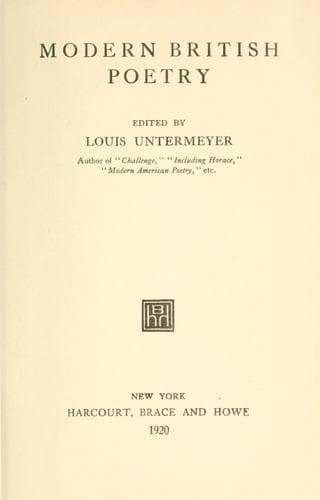
English poetry -- 19th century; English poetry -- 20th century
But most of the elegant and disillusioned young men overshot their
mark. Mere health reasserted itself; an inherent repressed vitality
sought new channels. Arthur Symons deserted his hectic Muse, Richard
Le Gallienne abandoned his preciosity, and the group began to
disintegrate. The aesthetic philosophy was wearing thin; it had already
begun to fray and reveal its essential shabbiness. Wilde himself
possessed the three things which he said the English would never
forgive--youth, power and enthusiasm. But in trying to make an
exclusive cult of beauty, Wilde had also tried to make it evade
actuality; he urged that art should not, in any sense, be a part of
life but an escape from it. "The proper school to learn art in is not
Life--but Art." And in the same essay ("The Decay of Lying") he wrote,
"All bad Art comes from returning to Life and Nature, and elevating
them into ideals." Elsewhere he said, "The first duty in life is to be
as artificial as possible. What the second duty is no one has
discovered."
Such a cynical and decadent philosophy could not go unchallenged. Its
aristocratic blue-bloodedness was bound to arouse the red blood of
common reality. This negative attitude received its answer in the work
of that yea-sayer, W. E. Henley.
WILLIAM ERNEST HENLEY
Henley repudiated this languid aestheticism; he scorned a negative art
which was out of touch with the world. His was a large and sweeping
affirmation. He felt that mere existence was glorious; life was
coarse, difficult, often dangerous and dirty, but splendid at the
heart. Art, he knew, could not be separated from the dreams and
hungers of man; it could not flourish only on its own essences or
technical accomplishments. To live, poetry would have to share the
fears, angers, hopes and struggles of the prosaic world. And so Henley
came like a swift salt breeze blowing through a perfumed and
heavily-screened studio. He sang loudly (sometimes even too loudly) of
the joy of living and the courage of the "unconquerable soul." He was
a powerful influence not only as a poet but as a critic and editor. In
the latter capacity he gathered about him such men as Robert Louis
Stevenson, Rudyard Kipling, Thomas Hardy, H. G. Wells, W. B. Yeats, T.
E. Brown, J. M. Barrie. None of these men were his disciples, but none
of them came into contact with him without being influenced in some
way by his sharp and positive personality. A pioneer and something of
a prophet, he was one of the first to champion the paintings of
Whistler and to proclaim the genius of the sculptor Rodin.
Public-domain text, read in full here on John Shaqi.
Reviews
Reviews
No reviews yet
Be the first to share your thoughts on this work.
Join the Discussion
Join the discussion
Sign in to leave a comment or review.
Sign InorCreate an account